An Eight-Year-Old Girl Cut a Patch Straight Off a 285-Pound Biker’s Leather Vest Inside a Crowded Route 66 Diner — Then He Recognized the Blue Stitches His Fallen Road Captain Had Left Behind
Part 2 — The Blue Thread Rook Refused to Replace
I closed the Copper Lantern early that afternoon.
Nobody complained.
Mara did not want Lucy inside a motorcycle clubhouse, so the Iron Saints agreed to meet at their workshop while she followed in her own car. Hammer rode alone. His vest lay folded in his saddlebag, the rectangular wound in its back still surrounded by severed black thread.
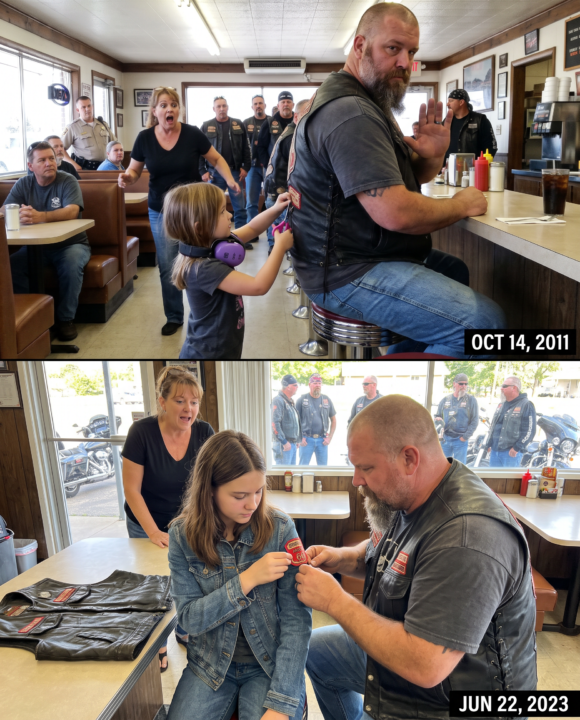
Lucy kept Owen’s patch on her lap.
Every few minutes, she touched the blue stitches.
I drove behind Mara because she had begun shaking too hard to follow directions. Deputy Ellison came in his own cruiser, officially to “preserve the peace,” though I suspect he was as curious as the rest of us.
The Iron Saints’ workshop occupied an old tire warehouse east of Flagstaff. No neon sign marked the building. Only a steel door, a gravel lot, and the low smell of gasoline, hot rubber, welding smoke, and coffee burned past rescue.
Hammer parked first.
Twenty-seven engines shut down behind him.
The silence afterward had weight.
Inside, the club walls held photographs from toy runs, veteran funerals, wildfire evacuations, and roadside recoveries. Rook appeared in more than half of them.
He was easy to find.
Owen Hale had been lean, sandy-haired, and almost always smiling at someone outside the frame. He wore the faded road-captain patch in every photograph taken after 2016.
In one picture, the blue repair stitches were bright enough to see from ten feet away.
Lucy stood beneath it.
“That’s mine.”
Mara looked at the photograph but did not approach. She had spent three years teaching herself that this building had taken something from her. Grief can harden around an explanation even when the explanation is wrong.
Hammer led us past the motorcycle lifts.
On the far wall were thirty metal storage lockers.
Number 17 had not been opened in three years.
Lucy inserted the key. It turned halfway, caught, then stopped.
Hammer crouched beside her.
“Lift while you turn.”
“Daddy taught me that with our back door.”
“Learned it from him.”
The lock opened.
Inside sat eight packages wrapped in brown paper. Each carried a number instead of a date: 5, 6, 7, 8, 9, 10, 11, and 12.
Lucy had already missed the first four.
Beneath them lay a small leather vest with no club colors, no skulls, and no name. Its back held an unfinished round patch showing a blue road curving beneath seven silver stars.
One star had not been sewn.
A red metal toolbox occupied the bottom shelf. Hammer removed it with both hands and placed it on a workbench.
Mara recognized the dents.
“Owen kept that in our garage.”
“He brought it here two days before the ride,” Hammer said.
“You helped him plan this?”
“No. I tried to stop him.”
That was the first crack in the story Mara had carried.
Owen’s illness had begun with headaches, forgotten words, and a left hand that sometimes opened without permission. Doctors found a glioblastoma pressing against the part of his brain responsible for speech and movement.
Treatment bought months.
Not years.
By the final summer, Rook could no longer ride safely. He surrendered his road-captain duties without argument, which told the club how frightened he was. This was a man who once navigated forty riders through a New Mexico dust storm using a paper map and the gas station lights he remembered from childhood.
Losing the road hurt.
Losing Lucy hurt worse.
Owen and Mara had separated during treatment, not because either stopped loving the other, but because fear changed the shape of every conversation. Owen became angry when his hands failed. Mara became controlling when his balance disappeared. Lucy began hiding under tables whenever adults raised their voices.
Then Owen suffered a seizure in front of her.
He woke on the kitchen floor and saw his four-year-old daughter holding a dish towel against his bitten tongue. After that, he refused to let her watch the illness take more.
He moved into an apartment above the Iron Saints’ workshop.
Mara believed he chose the club.
In truth, Rook chose to let Lucy remember him standing.
That decision was loving.
It was also wrong.
Hammer told him so.
“You don’t get to decide which version of you she loves,” he had said.
Rook replied, “I get to decide which version scares her.”
The argument lasted two days.
On the third, Lucy visited the workshop with Mara to bring Owen’s medication. She found the road-captain patch tearing loose from his vest and insisted on fixing it.
Her stitches wandered like a child’s drawing.
Colt offered to repair them properly.
Rook nearly broke his hand.
“Nobody touches the blue.”
From then on, the club treated those six crooked stitches as part of the colors.
Lucy never knew.
The red toolbox contained photographs, medical paperwork, several memory cards, and a compact digital recorder wrapped in one of Owen’s old Army undershirts.
Hammer did not touch it.
“That belongs to them,” he said.
Mara stared at the eight packages.
“Why weren’t these mailed?”
“First one was.”
“The box you left in the rain?”
Hammer nodded.
“I thought it was club merchandise.”
“It held her fifth-birthday letter and a wooden horse Rook carved.”
Mara closed her eyes.
Hammer did not blame her.
That made it worse.
Colt stepped forward. He was fifty-one, broad through the shoulders, with a gray mustache and a steel brace beneath his jeans from an old highway crash.
“We voted after that,” he said.
Mara looked at him. “Voted on what?”
“Whether Hammer could keep wearing Rook’s patch.”
Club custom required a fallen member’s identifying pieces to be returned to the family or retired on a memorial wall. Hammer refused both.
He would not explain why.
Rook had made him swear that the hidden key and patch would reach Lucy only when Mara was ready—or when Lucy recognized the patch herself.
The club saw theft.
Hammer accepted suspension as president, surrendered his voting rights, and rode at the back of every formation for fourteen months.
“Why not tell them?” Mara asked.
“Promise wasn’t theirs,” Hammer replied.
Lucy lifted package number eight.
“This one is for now.”
Nobody had planned that.
The package had been written for her eighth birthday, only six days earlier.
Inside was a box of blue thread, a child-safe sewing needle, and a folded note.
Lucy read it silently.
Then she handed it to her mother.
Rook’s handwriting had deteriorated, but one line remained steady:
If the road patch ever finds you, check whether Hammer kept your stitches. He acts hard, but promises scare him more than fists.
Lucy looked across the workshop.
Hammer had turned away.
She called his name.
The giant biker faced her.
“You kept them.”
“Yep.”
“Even in the rain?”
“Covered the vest.”
“Why?”
He rubbed one thumb across a scarred knuckle.
“Your dad asked.”
It was the smallest answer in the room.
It carried three years.
Part 3 — What Happened During the Final Eleven Miles
Mara did not want to play the recorder.
Lucy did.
The argument stayed quiet, which somehow made it harder to witness.
“She is eight,” Mara said.
“He made it for me,” Lucy answered.
“He made it when he was sick.”
“He was still my dad.”
Mara turned to Hammer, expecting support.
Hammer leaned against the workbench with his damaged vest over one arm.
“Her call.”
“You don’t get a vote.”
“Wasn’t voting.”
The old anger returned to Mara’s face. For three years, she had believed Hammer pushed Owen onto a motorcycle that his doctors had forbidden him to ride.
The newspaper story supported her.
FALLEN BIKER DIES AFTER FINAL RUN THROUGH OAK CREEK CANYON.
It sounded romantic enough for strangers and cruel enough for a widow.
The truth was less clean.
Owen planned the ride without the club.
At 4:40 on an August morning, he dressed alone, removed the balance brace from his left leg, and rolled his Harley out of the warehouse so the starter would not wake anyone upstairs.
Hammer heard the kickstand.
He came down barefoot with a pistol in one hand because he thought someone was stealing a motorcycle.
Instead, he found Rook struggling to fasten his helmet.
“You’re not riding.”
“Move.”
“Can’t work the buckle.”
“I’ll figure it out.”
“You can’t feel your left hand.”
Rook looked toward the paling sky.
“Then ride on my left.”
Hammer took the key.
Rook punched him.
The blow barely moved Hammer, but it knocked Owen off balance. He struck the wall, slid to the floor, and began laughing.
Then he cried.
Not loudly.
That would have been easier.
He sat between two motorcycles and admitted he had recorded seven birthday messages but could not finish the eighth. Every attempt sounded like a patient saying goodbye.
He wanted Lucy to remember his voice before the tumor slowed it beyond recognition.
He believed he could find that voice at the overlook where he had taken Mara on their first motorcycle date.
Hammer offered to drive him in the truck.
Rook refused.
“Last memory can’t smell like vinyl seats.”
At dawn, the other riders found them arguing.
The club took a vote.
Nobody supported the ride.
Rook walked to the center of the workshop, removed his road-captain patch, and handed it to Hammer.
The blue stitches faced outward.
“If I don’t come back, wear it.”
“No.”
“Until Lucy takes it.”
“No.”
“She’ll know the corner.”
Hammer closed his hand around the patch.
Rook then revealed the second part.
He would ride in a sidecar attached to Moses Carter’s touring bike. He had arranged it weeks earlier with Doc, the club’s former Army medic. He would not control a motorcycle. He would wear a medical harness. An oxygen kit and seizure medication would travel in the chase vehicle.
Hammer still opposed it.
Owen leaned close.
“You taught me a man can be dying and still be here. Don’t change the lesson now.”
That struck where Rook intended.
Years earlier, Hammer had spent thirty months in prison after nearly killing a man during a bar fight. When he came out, most riders wanted nothing to do with him. Owen hired him at his small engine shop, drove him to sobriety meetings, and handed him tools without counting them afterward.
Rook did not save Hammer with speeches.
He gave him a place to arrive each morning.
So Hammer agreed to eleven miles.
Not the canyon.
Not Sedona.
Eleven controlled miles from the workshop to a roadside overlook north of town, with a medical truck behind them.
The newspapers got that wrong.
The club did not.
Twenty-eight motorcycles left Flagstaff at sunrise. Engines rolled low through empty streets while Rook rode in the sidecar beneath a wool blanket, his road-captain patch held against his chest because he no longer wore a vest.
At the overlook, he asked for the recorder.
He spoke for nine minutes.
The first three were unusable. He forgot Lucy’s age, called August “April,” and stopped halfway through a sentence about blue roads.
He struck his own leg in frustration.
Hammer moved the recorder away.
Rook grabbed his wrist.
“Again.”
On the fourth attempt, his voice returned.
Not completely.
Enough.
He told Lucy about the kitchen lamp, the needle prick, and the six blue stitches. He told her roads on maps were sometimes red, black, or yellow, but she could keep drawing them blue.
Then he said something none of the riders expected.
“Your mother did not keep me from you.”
Mara’s hands tightened around the recorder as the message played inside the workshop.
“I stayed away because I was scared you would remember the floor, the ambulance, and my mouth bleeding after the seizure. That choice hurt your mother. It hurt you. I thought fear made it necessary. I was wrong.”
Lucy looked at her mother.
Mara covered her face.
The recording continued.
“I loved you while I was near. I loved you while I was hiding. Both things were true. Only one was brave.”
Hammer had heard those words once before.
At the overlook.
After the recording, Owen asked to return by truck. The ride had taken everything.
Moses lifted him from the sidecar. Doc checked his pulse. Rook made a joke about road captains becoming luggage.
Everyone relaxed.
Too soon.
Eleven minutes into the drive home, Owen began seizing.
Doc administered medication. The seizure stopped, then started again. Hammer climbed into the moving medical van and held Owen on his side while Moses drove toward Flagstaff Medical Center.
The other riders blocked intersections.
That part became the public image: bikers racing through town around an ambulance van, appearing to celebrate while a dying man fought for air inside it.
A driver recorded them.
The clip reached local news before Mara reached the hospital.
Owen never regained full consciousness.
He died shortly after noon.
Mara arrived to find Hammer outside the emergency entrance wearing her husband’s patch.
She did not know Owen had given it to him.
She saw only a huge biker wearing the missing piece of a dead man’s vest.
Hammer tried to explain.
Mara slapped him.
Then she told security to remove every Iron Saint from the hospital.
The club obeyed.
Hammer did not.
He waited in the parking lot for seven hours because Owen’s final instruction had been simple:
Do not let Mara drive home alone.
When she finally left with her sister, Hammer followed two blocks behind until she reached her house safely.
Mara never saw him.
Or thought she did not.
On the recorder, after forty seconds of wind, Owen’s voice returned one final time.
This portion had never been mentioned in the newspaper.
It had never been played for Mara.
“Ray, if I don’t make it, don’t let them turn this into a beautiful ride. Dying isn’t beautiful. Mara cleaning medicine off the floor wasn’t beautiful. Lucy hiding under the table wasn’t beautiful.”
A breath.
Then another.
“Tell them I was scared.”
Hammer looked down.
The recorder hissed.
“And tell my girl I still went.”
The file ended.
Nobody spoke.
Mara crossed the room and stood before Hammer.
For a moment, I thought she might strike him again.
Instead, she asked the question that had poisoned three years of her life.
“Did the ride kill him?”
Doc answered.
“No. His final scan showed catastrophic swelling. He likely had hours whether he stayed in bed, rode in the sidecar, or sat in a hospital room.”
“Why didn’t anyone tell me?”
“We tried.”
Mara looked at Hammer.
“You could have forced me to listen.”
Hammer shook his head.
“Grief ain’t a door you kick in.”
Lucy held the road-captain patch between both palms.
“My daddy was scared?”
Hammer knelt.
“Terrified.”
“But he went.”
“Yep.”
“Did that make him brave?”
Hammer thought before answering.
“No. Telling you he was scared did.”
That should have been the climax.
It was not.
Because Colt had not yet explained why the Iron Saints blamed Hammer for something that happened after Owen died.
Part 4 — The Vote That Put Hammer at the Back
Three days after Rook’s funeral, the Iron Saints gathered in the workshop.
Mara had barred them from attending the service in their cuts. Most went anyway, standing across the road in plain shirts where Lucy could not see the club colors.
Hammer stayed away.
Not because Mara ordered it.
Because he was afraid he might return Owen’s patch and break the last promise the man had trusted him to keep.
That choice split the club.
Colt demanded the patch be delivered to the family. Moses argued that Owen’s spoken instruction mattered. Others believed grief had confused him and no club oath should keep a child from her father’s property.
Hammer refused to repeat the private conversation.
He simply said no.
The vote removed him as president until he returned the patch or explained himself.
Hammer placed his president rectangle on the table.
Then he moved his motorcycle to the rear of every formation.
“He let us think he was stealing from a dead brother,” Colt told Mara. “That’s why I came out of my chair when Lucy started cutting. I thought she was doing what none of us had the nerve to do.”
Colt opened a cabinet and removed a clear plastic evidence sleeve.
Inside was Hammer’s old president patch.
They had preserved it for fourteen months.
“What changed?” I asked.
Moses answered from the doorway.
“I found the first letter.”
After Owen’s death, the club cleared his apartment. Beneath the mattress, Moses discovered a carbon copy of a note addressed to Hammer.
The original had been placed inside the road-captain patch beside the brass key, but sweat and rain had damaged most of it. The copy confirmed Rook’s instructions.
Wear this until Lucy recognizes her blue thread. If Mara accepts it sooner, give it back. If she does not, protect her anger. She has carried enough.
Hammer had done exactly that.
He accepted Mara’s accusation.
He accepted the club’s punishment.
He accepted strangers calling him a thief at memorial rides where Owen’s old friends recognized the patch.
He never answered with Rook’s private words.
The club restored him as president.
Hammer refused the patch for another five months.
“Why?” Lucy asked.
Hammer looked at Colt.
“Wasn’t done earning the back row.”
There was more.
On Lucy’s fifth birthday, Hammer brought the first package to Mara’s house. He went alone, without his motorcycle, because Owen had written that the engine noise frightened Lucy after the seizure.
Mara saw him through the window.
She did not open the door.
Hammer left the package beneath the porch roof, but a monsoon wind blew it into the yard. By the next morning, the wooden horse had split and the letter’s ink had bled away.
Hammer recovered both from the trash.
He repaired the horse.
Then he put it in Locker 17.
On Lucy’s sixth birthday, he did not approach the house. He delivered a card through Mara’s attorney.
It came back unopened.
On her seventh, he mailed only the locker number and key instructions. The envelope was returned because Mara had moved.
Hammer found the new address.
He still did not go.
“Why not?” Mara asked.
“Your lawyer said contact would be harassment.”
“He was handling Owen’s estate. I never asked for that.”
“He showed me a letter.”
Mara stared at him.
“What letter?”
Hammer crossed to a filing cabinet and removed a photocopy.
The letter used Mara’s name and old signature. It demanded that the Iron Saints cease all contact and destroy any remaining recordings Owen had made while cognitively impaired.
Mara read it twice.
“I didn’t sign this.”
Deputy Ellison examined the page.
The letter had come from the office of Martin Vale, the estate attorney hired by Owen’s estranged older brother, Kenneth.
Kenneth believed the Iron Saints were trying to control Owen’s modest life-insurance payment. He had challenged the validity of several documents, including Owen’s request that part of the policy fund Lucy’s education and part support a free motorcycle transport program for rural veterans.
The club never received money.
They never asked.
Yet Kenneth sent the no-contact letter to ensure they would not produce Owen’s later recordings or interfere with probate.
Another piece fell into place.
Mara had wondered why Owen’s red toolbox vanished from the estate inventory. Kenneth told her the club took it from the crash scene.
In reality, Owen moved it himself before the final ride.
Kenneth had not stolen the toolbox.
He had stolen the chance for Mara to know it still existed.
Deputy Ellison stepped outside to call an investigator.
Hammer remained beside Locker 17.
He showed no satisfaction.
Mara looked at him. “You knew the signature might be false?”
“No.”
“But you still kept making the birthday packages.”
“Rook made most. I added what was missing.”
“What was missing?”
“Postage, mostly.”
For the first time that day, Mara laughed.
It came out broken, but it came.
Lucy opened package number five.
Inside was the repaired wooden horse, a faded photograph of Owen holding her as a newborn, and a note Hammer had written after the original ink washed away.
Your father said this horse was supposed to look wild. It looked like a dog, so I fixed the legs. Now it looks like a taller dog.
Lucy examined the carving.
“It does.”
“Yep.”
Package six held Owen’s old Army compass and a map with a blue route drawn between every house where Lucy had lived.
Package seven contained a set of small tools. Each handle had been wrapped in purple tape so a child could grip it.
Package eight—the one Lucy had already opened—held the blue thread.
The packages for nine through twelve were still sealed.
Mara reached for number nine.
Hammer stopped her.
“Not yours.”
“She is my daughter.”
“Still not yours.”
Mara’s face tightened.
Then Lucy placed one hand on her mother’s wrist.
“Next year.”
Mara let go.
That small decision mattered.
For three years, adults had chosen which truths Lucy could survive. Owen chose. Mara chose. Hammer chose. The club chose.
Now Lucy chose.
She lifted the unfinished child-sized vest from the locker.
“Why is one star missing?”
Hammer touched the empty space.
“Your dad finished seven. Hand quit working.”
“Can you sew?”
“No.”
Lucy looked at his tattoos, beard, skull ring, and hands large enough to cover the entire patch.
“I can teach you.”
A few riders turned away.
Bikers do that when emotion gets too close. They inspect engines, windows, coffee cups—anything that cannot watch them back.
Hammer sat at the workbench.
Lucy threaded the needle.
His first stitch was worse than hers.
She made him remove it.
His second pulled the cloth too tight.
She made him remove that too.
On the third attempt, Hammer passed the blue thread through the final silver star and returned it without knotting.
“Finish it,” he said.
Lucy tied the knot.
The unfinished road was finished.
But she still had not decided what to do with her father’s patch.
Part 5 — The Man Rook Asked Hammer to Bring Home
The investigator confirmed the forged letter two days later.
Kenneth Hale admitted sending it. He claimed he wanted to protect Owen’s family from “club manipulation,” but the probate court found he had also redirected notices concerning the veterans’ transport fund.
Mara could have turned the discovery into another public battle.
She did not.
She asked for the recordings, the corrected estate papers, and nothing more.
Hammer respected that.
The Iron Saints had their own unfinished matter.
The final audio file in the red toolbox carried Hammer’s name.
He refused to play it.
Lucy asked why.
“Wasn’t made for you.”
“Was it made for you?”
“Yep.”
“Then you’re allowed.”
“Allowed ain’t the same as ready.”
Lucy considered this.
It was the kind of answer adults gave children when they wanted time.
She let him have it.
Three weeks passed.
The diner video still circulated online. Most posts ended at the instant Lucy tore away the patch, making her look endangered and Hammer look furious.
Longer footage showed him kneeling.
People changed the story from “child attacks biker” to “biker forgives child.”
Both versions missed the point.
Hammer had nothing to forgive.
The patch was hers before it was his.
On the fourth Saturday, Mara and Lucy returned to the workshop. They found Hammer rebuilding a carburetor at the far bench.
Owen’s patch hung from a hook beside him.
He had not sewn it back.
Lucy set the digital recorder near his wrench.
“You forgot this.”
“Nope.”
“You’re still not ready?”
“Nope.”
She sat on a stool.
Hammer continued working.
Lucy waited.
Silence is uncomfortable only if you believe it must be filled. Children and bikers sometimes understand that better than everyone else.
After ten minutes, Hammer wiped his hands.
He pressed play.
Rook’s voice entered the workshop.
“Ray, if you’re hearing this, either I died or Moses finally learned how to work the recorder. Odds favor me dying.”
Moses cursed softly.
Even Mara smiled.
The message continued.
Owen spoke about the first day Hammer entered his repair shop after prison. Ray had arrived twenty minutes early, stood outside in rain, and refused to come in because his boots were muddy.
Rook knew then that the violent man described in court records was not the entire man.
He gave Hammer a broom.
Hammer returned the next day.
Then the next.
Within a year, he could rebuild nearly anything with a motor. Within two, he was sober. Within four, he became the rider others trusted when a road narrowed or a storm erased the lane markings.
“You think I brought you home,” Owen said. “Truth is, I kept handing you directions. You did the riding.”
Hammer stared at the floor.
Then came the sentence Owen had hidden from everyone else.
“I’m asking you to bring me home now.”
Hammer’s brow tightened.
Rook explained.
Not his body.
Not his motorcycle.
His name.
He did not want Lucy growing up with a polished story about a fearless father who rode bravely into death. That version would become impossible for her to resemble. It would make her ashamed whenever she felt afraid.
He wanted Hammer to return the man who forgot words, resented help, hurt his wife, hid from his daughter, and still loved them both.
“Don’t build me into something she has to worship,” Rook said. “Let her know me.”
The recorder clicked.
Hammer’s beard moved as his jaw clenched.
“Last part,” Lucy said.
“There’s more?”
Thirty seconds of wind followed.
Then Owen whispered, “And Ray—wear the patch only as long as it takes. You were already my brother before I gave you cloth.”
The file ended.
Hammer reached for the road-captain patch.
Lucy reached first.
“What do you want done with it?” he asked.
She turned it over, studying the blue corner and the faint marks left by three years of rain.
“Mom?”
Mara touched Owen’s handwriting beneath the empty rectangle on Hammer’s vest.
LET HER CHOOSE THE ROAD.
“It’s your decision.”
Lucy asked whether a patch could belong to two people.
Colt answered too quickly.
“No.”
Moses struck his arm.
Hammer ignored both.
“Things belong where they’re carried right,” he said.
Lucy took the sewing kit from her backpack.
She placed Owen’s patch over the rectangle on Hammer’s leather, exactly where it had been.
Then she began sewing.
Not permanently.
She used wide blue loops that could be cut again without damaging the leather.
Hammer sat motionless while she worked behind him. His shoulders were broad enough to block the window, but Lucy leaned around them each time she needed more light.
When she finished, the patch sat slightly crooked.
Colt opened his mouth.
Hammer looked at him.
Colt shut it.
Lucy gave Hammer the scissors.
“What are these for?”
“If I want it back.”
Hammer folded them and placed them in the inner pocket of his vest.
“Fair.”
Mara watched from across the room.
“You’re letting an eight-year-old decide when you stop wearing it?”
“Rook did.”
That night, the Iron Saints restored Hammer’s president patch.
He did not put it above Owen’s.
He placed it on the front, smaller and lower, where he could see it only by looking down.
The road-captain patch stayed on his back.
That was where other riders could see it.
That was where Lucy had chosen to carry her father.
Part 6 — Eight Miles on Every August Morning
The ritual began the following year.
On Lucy’s ninth birthday, Hammer arrived outside Mara’s house at 8:00 a.m. He did not rev the engine. He parked a block away and walked the final distance carrying package number nine.
Mara opened the door.
That was new.
Lucy wore the child-sized leather vest. The seven silver stars crossed her back, and the eighth star—stitched by her and Hammer—sat slightly higher than the rest.
Package nine contained a letter, a photograph, and a small red road map.
Owen’s message gave directions to the overlook where he recorded his goodbye.
Mara drove.
Lucy rode in the truck with her.
Hammer and five Iron Saints followed at a distance. At the overlook, they shut off their engines and waited beside the guardrail while Lucy listened to her father describe the morning light.
He had remembered it correctly.
The rock face turned copper first. Then the pines brightened.
Lucy placed the wooden horse beneath the rail for one minute, picked it up, and carried it home again.
Nothing was left as a shrine.
Rook had asked for a road forward.
Each August brought another package.
At ten, Lucy received Owen’s favorite socket wrench and a letter admitting he had lost it twice while holding it in his hand.
At eleven, she received his Army compass.
At twelve, she found the final silver star he had attempted to sew before his fingers stopped cooperating.
She added it beside hers.
Hammer continued visiting the Copper Lantern.
He sat in the same counter seat beneath the Route 66 clock. The cut in his vest slowly widened around Lucy’s loose blue stitches, but he never replaced them.
Once, I asked whether he worried the patch would fall off on the highway.
“Won’t.”
“How do you know?”
“I check before every ride.”
That was true.
Before starting his Harley, Hammer reached behind his shoulder and touched the blue corner.
Six crooked stitches had once held it.
Now twelve did.
Mara eventually allowed Lucy to ride in a sidecar during the annual veterans’ food drive. She made Hammer install a second restraint, provide inspection records, limit the route to eight miles, and keep the speed below thirty-five.
He agreed to everything.
Lucy wore Owen’s vest beneath a bright yellow jacket.
At the first stoplight, she tapped the sidecar twice.
Hammer looked down.
She pointed at the blue road on her patch.
Then she pointed forward.
The light changed.
The V-twin answered softly.
Part 7 — The Day Lucy Used the Scissors Again
Five years after the diner fell silent, Lucy returned to the Copper Lantern with the same pair of scissors.
She was thirteen now.
Taller. Quieter. Still missing none of the details adults hoped she would forget.
Hammer sat at the counter drinking black coffee. Gray had taken most of his beard, and arthritis had begun stiffening two fingers on his right hand.
Owen’s patch remained on his back.
The blue stitches had been replaced twice, always by Lucy and always loosely enough to remove.
She stood behind him.
The diner noticed.
Word of the first cutting had become local history. Several regulars lowered their forks. Colt, older and no wiser, turned halfway in his booth.
Hammer did not look around.
“Today?” he asked.
“Today.”
He removed his vest and placed it on the counter.
Lucy cut the threads.
No screaming.
No raised phones.
Just two soft closures of metal blades.
Snip.
Snip.
The patch came free.
Hammer examined the empty rectangle beneath it. Rook’s silver words had faded until only three remained visible:
CHOOSE THE ROAD.
Lucy carried the patch to a booth where Mara waited with a new denim riding jacket. She positioned it across the back, but before sewing, she added a narrow strip beneath it.
The strip carried no club name.
Only two words:
STILL HERE.
“Your dad’s?” Hammer asked.
Lucy shook her head.
“Ours.”
She sewed the patch onto her jacket with blue thread.
Her stitches were straight now.
Hammer watched the needle pass through the cloth. When she finished, she turned so he could inspect the work.
He tugged one corner.
“Too tight.”
“I don’t plan to give it back.”
“Fair.”
Outside, an old Harley waited beside Mara’s truck. Hammer no longer led long formations, but he still rode the annual eight-mile route to the overlook.
Lucy climbed into the sidecar.
Before lowering her helmet, she asked the question she had carried since childhood.
“Did Dad know I would find you?”
Hammer fastened his gloves.
“No.”
“Then why make you wear it?”
“So I couldn’t hide.”
That answer satisfied her.
The engine started.
Leather creaked. The chain beside Hammer’s wallet rattled. Lucy touched the patch on her back, and Hammer reached toward the empty place on his own vest.
For the first time in eight years, nothing was there.
He smiled anyway.
Mara followed in the truck as the motorcycle rolled east beneath the morning sun, one old biker at the controls and one road captain’s daughter carrying the blue stitches behind him.
The patch had finally come home.
Drop ROOK in the comments and follow the page for more biker stories about promises that survive the final ride.