She Was Followed After Her Night Shift — And The Biker Engine That Wouldn’t Leave
She thought the sound behind her was just traffic—until it followed her through three empty blocks and didn’t fade away.
It was 12:47 a.m. in a small town outside Denver. The diner’s neon sign flickered like a tired heartbeat. Inside, the last coffee cup had been rinsed. The floor still smelled faintly of bleach and burnt bacon grease. Outside, the street was mostly dark.
Emma Parker, twenty-three, blonde hair tied into a loose bun, navy waitress uniform wrinkled from a double shift, stepped into the cold air with her backpack slung over one shoulder.
She checked her phone.
Two missed calls from her mom.
She smiled faintly, then locked the screen.
The parking lot felt too open.
Too quiet.
Her car sat near the edge of the lot, under a streetlamp that buzzed and flickered like it was debating whether to stay alive.
She heard footsteps.
Not close. Not yet.
But steady.
She didn’t turn around immediately. She didn’t want to look paranoid. The world teaches women that fear is exaggeration—until it isn’t.
Her steps quickened.
The footsteps matched.
That was when her chest tightened.
She reached her car. Hands trembling. Keys slipping. The sound of metal scraping against metal as she missed the lock twice.
Behind her—
A man in his thirties. Hood pulled up. Hands buried in his jacket pockets. Walking straight toward her.
“Hey,” he called.
Her throat went dry.
“I just wanna ask you something.”
She didn’t respond.
He kept coming.
The parking lot suddenly felt like a stage with no exits.
A delivery driver across the street glanced up from his phone… then looked away.
A couple exiting a bar down the block saw the scene. Hesitated. Turned back inside.
Silence is louder than shouting when you’re alone.
“Don’t ignore me,” the man said, voice sharper now.
Emma yanked the car door open, but before she could slide inside—
A low engine growl rolled into the lot.
Not fast.
Not dramatic.
Just steady.
The headlight cut across the pavement like a white line drawn between her and the man.
A motorcycle eased in and stopped between them.
The rider didn’t remove his helmet.
Didn’t say anything.
Just sat there.
The engine idling.
A barrier of chrome and steel.
Emma’s heart pounded in her ears.
The man in the hoodie paused.
The biker slowly took off his helmet.
Mid-forties. Dark hair streaked with gray. Short beard. Black leather vest over a plain gray T-shirt. Tattoos coiled along his forearms.
He didn’t glare.
He didn’t shout.
He simply looked at the man.
And the engine didn’t turn off.
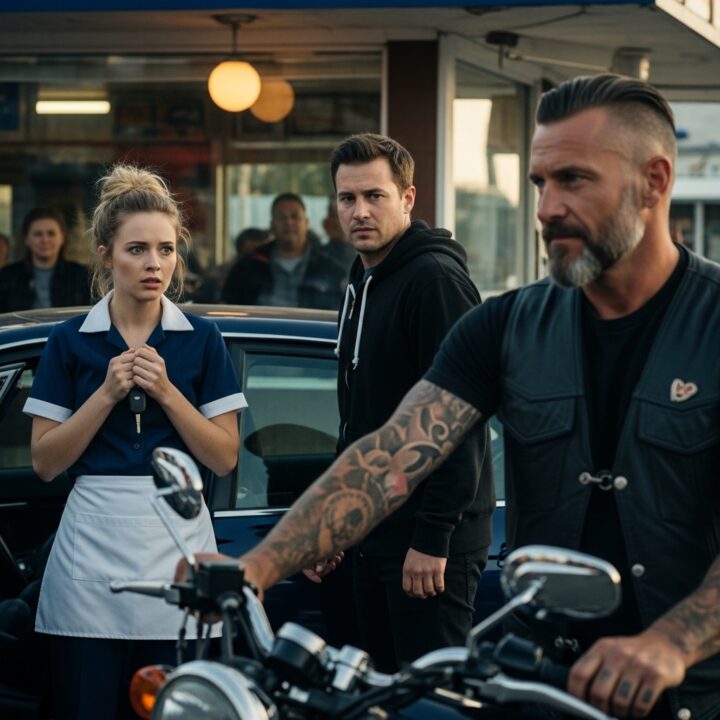
“What’s the problem?” the biker asked, voice even.
Emma couldn’t speak yet.
The hooded man scoffed. “No problem. Just talking.”
The biker didn’t move.
Didn’t blink.
The motorcycle’s engine continued its low, mechanical heartbeat in the silence.
“It didn’t look like talking,” he said.
Now the tension shifted.
The hooded man stepped back slightly, but pride forced his chin upward.
“You her dad or something?”
The biker ignored the question.
He turned slightly toward Emma.
“You good?”
She nodded too fast.
Too automatic.
The kind of nod women give when they want everything to end without escalation.
The biker noticed.
The hooded man noticed too.
“Man, mind your business,” the stranger snapped.
The biker swung his leg off the motorcycle.
That single motion changed the air.
From a distance, it looked aggressive.
Leather vest. Tattoos. Heavy boots hitting pavement.
The silhouette of trouble.
A car slowed at the edge of the lot. A woman inside lifted her phone to record.
Because now it looked like a fight.
The hooded man shoved his hands deeper into his pockets.
“You threatening me?”
The biker shook his head once.
“No.”
But he stepped closer.
And that was enough.
Someone inside the diner pressed against the window.
The owner, a heavyset man in his fifties, rushed outside.
“Hey! No fighting on my property!”
He looked at the biker first.
Of course he did.
Leather always gets blamed first.
The biker raised one hand slightly. Open palm.
“Not fighting.”
Emma finally found her voice. “He was following me.”
Her words came out small.
Almost apologetic.
The hooded man laughed. “I was walking to my car!”
The biker’s jaw tightened just a fraction.
He moved half a step sideways—placing himself between Emma and the stranger.
Not touching either.
Just positioning.
But that positioning made it worse in the eyes of bystanders.
Because now it looked territorial.
Possessive.
Aggressive.
The diner owner pulled out his phone. “I’m calling the cops.”
The biker nodded once.
“Good.”
That confused everyone.
The hooded man scowled. “You crazy?”
The biker’s voice stayed level.
“Stay right there then.”
His calmness felt heavier than shouting.
Emma could feel her heartbeat in her wrists.
The hooded man shifted his weight, glancing around.
People were watching now.
Filming.
Whispering.
The narrative formed instantly in their heads:
“Biker intimidating guy in parking lot.”
Not “Girl cornered after midnight shift.”
The hooded man muttered, “This is stupid,” and began to step backward.
The biker didn’t chase.
Didn’t threaten.
He simply stood.
And kept the engine running.
The red and blue lights arrived minutes later.
Police cruisers pulled in sharp.
Officers stepped out quickly.
And who did they approach first?
The biker.
Hands visible.
Voice firm.
“Sir, step away from the vehicle.”
Emma felt panic spike again.
This was spiraling.
The hooded man started talking fast.
“He jumped me! Came at me!”
The crowd nodded uncertainly.
The biker complied calmly.
Hands up.
Helmet resting on the seat.
He didn’t explain much.
Didn’t argue.
Just looked toward Emma once.
And said quietly—
“You tell them.”
Emma’s voice trembled as she described the footsteps. The matching pace. The tone that shifted.
The officer listened carefully—but his eyes kept drifting toward the biker’s tattoos.
“Sir, what’s your involvement?”
The biker answered simply.
“I saw enough.”
“That doesn’t give you authority.”
“I didn’t claim it did.”
The officer frowned.
The hooded man insisted, louder now. “He threatened me! Look at him!”
The diner owner added nervously, “I don’t want violence here.”
Violence.
The word hung heavy.
As if it had already happened.
As if leather meant inevitable harm.
The officer turned to the biker again.
“You escalated this.”
The biker’s expression didn’t change.
“No.”
But he didn’t elaborate either.
That silence worked against him.
The hooded man crossed his arms.
Smirked.
Emma felt something twist inside her chest.
This was slipping away.
The officer asked for IDs.
Everyone complied.
The biker pulled his wallet slowly. No sudden moves.
Inside, tucked behind his license, was a laminated card.
The officer’s eyebrows lifted slightly.
But he didn’t comment.
Not yet.
Emma watched, confused.
The officer stepped aside to radio something in.
The parking lot felt like it was holding its breath.
The hooded man leaned toward Emma again, voice low enough that only she heard:
“See what you started?”
Her stomach dropped.
The biker heard it too.
He didn’t lunge.
Didn’t react.
He simply took out his phone.
Typed one short message.
Then slipped it back into his pocket.
The officer returned.
His tone shifted—just slightly.
“Sir,” he said to the hooded man, “we’re going to check security footage from the diner.”
The man’s confidence flickered.
The biker stood still.
Engine still running.
The officer turned toward him.
“And you—who did you just text?”
The biker’s reply was short.
“Someone who watches this street.”
No explanation.
No detail.
The officer narrowed his eyes.
Minutes passed.
Long ones.
The cold air sharpened.
Then—
Another engine.
Not loud.
Not roaring.
But familiar.
And then another.
And another.
Emma felt it before she saw it—
The sound didn’t leave. It multiplied.