Kicked Out for Wearing a Biker Vest — By Nightfall, an Entire Neighborhood Stayed Awake
They threw him out into the cold for wearing a biker vest, and by midnight the same block would realize how wrong their fear had been.
The boarding house sat on a tired street in a Midwestern town—brick faded, porch light buzzing, the kind of place that took cash and didn’t ask questions. Inside, the air smelled like detergent and old carpet. Voices overlapped. A TV murmured somewhere. The owner’s patience was thin.
The man stood in the hallway with a small duffel at his feet, hands open, empty, as if proof he wasn’t carrying trouble. He was in his late forties, broad-shouldered, beard trimmed short. Over a gray T-shirt, he wore a black leather vest—no patches that shouted, just worn seams and a weight that came from years of use.
“You can’t stay here dressed like that,” the owner said, eyes flicking to the vest. “You’re making people nervous.”
A woman peered from behind a door. A man paused on the stairs, deciding whether to watch or pretend not to.
“It’s cold out,” the biker said, voice steady. “I paid for the night.”
The owner shook his head. “Rules.”
There were no written rules. Only fear dressed up as policy.
The biker picked up his duffel. He didn’t argue. Didn’t posture. He walked out into the evening as the porch light clicked off behind him.
Across the street, a few residents watched from windows, relieved. The problem, they told themselves, had been removed.
None of them noticed the way he paused at the curb, scanning the block, listening.
None of them knew why he was really there.
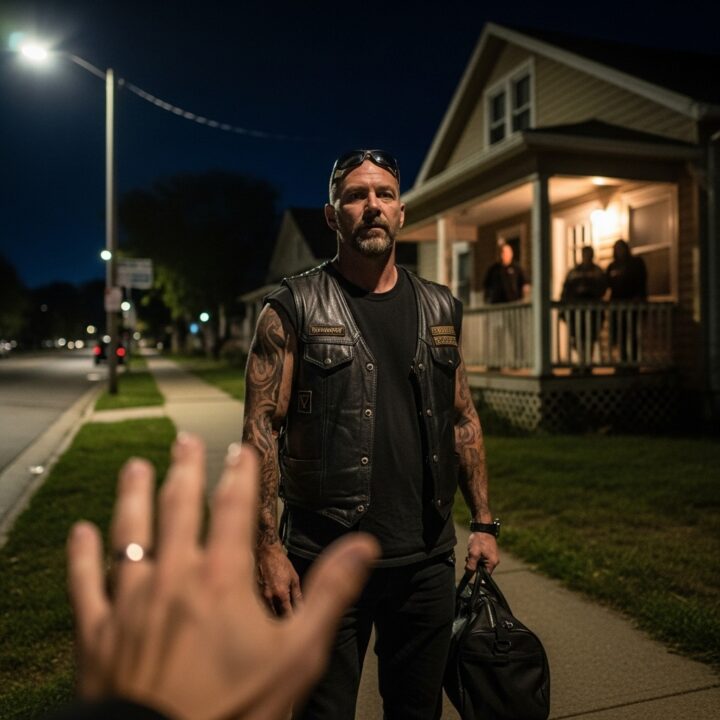
He didn’t leave the neighborhood.
He set his duffel down by a closed storefront and leaned against the brick, standing watch without being seen. Cars passed. Porch lights went dark one by one. The street settled into its nightly hush.
When the first shout cut through the quiet, heads turned.
It came from two houses down—a raised voice, sharp and panicked. Then another. A door slammed. Footsteps ran.
The biker pushed off the wall and moved.
A young couple stood on a front lawn, arguing with a man who swayed slightly, breath sour with alcohol. A toddler cried from inside the house. The scene teetered—one wrong word away from something worse.
The biker stepped between them.
To the couple, it looked exactly like what they feared: a biker inserting himself, blocking, looming. The man with the bottle scoffed and puffed up. A neighbor shouted, “Hey—back off!”
The biker raised a hand, palm open. “Not here,” he said. “Not like this.”
Someone called the police.
Phones came out. Whispers multiplied. A leather vest became a verdict.
The biker didn’t touch anyone. He didn’t threaten. He simply stood there, a quiet barrier, eyes moving, posture disciplined. The drunk man cursed and stumbled away. The couple retreated inside, shaking.
Red and blue lights painted the siding. Officers arrived to a chorus of explanations that sounded suspiciously alike: He started it. He’s intimidating. He shouldn’t be here.
The biker answered only when asked. Short sentences. Calm tone. No defensiveness.
The officers warned him to move along.
He nodded. Picked up his duffel. Walked back to the storefront.
From windows, people watched him go and felt justified.
Near midnight, a transformer popped at the end of the block.
Lights died. The street plunged into darkness. A collective groan rose—then silence, the kind that makes small sounds feel enormous.
Somewhere, a woman screamed.
The biker was already moving.
He ran toward the sound, boots quiet, heart rate steady. A house sat half-lit by moonlight, smoke whispering from a basement window. A space heater lay tipped near a laundry pile. The smell hit—hot plastic, dust, panic.
A man pounded on the door, shouting a name. Inside, a child cried.
The biker pulled his phone, typed one message, sent it. He didn’t say who it was to. He didn’t explain.
He yanked the breaker at the side of the house, killing what little power remained. He grabbed a garden hose, cranked it open, and pushed water toward the smoke. He kept his body low, breathing measured, thinking in steps.
Neighbors gathered, frozen. Someone yelled, “Don’t go in!” Another screamed for the fire department, as if that alone could move time faster.
The biker kicked the basement door, once, twice—wood giving with a crack. Heat rolled out. He disappeared inside.
For a long minute, nothing happened.
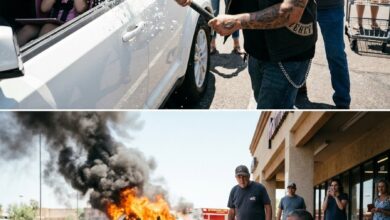
Then he emerged carrying a child wrapped in his vest, the leather turned shield, smoke streaking his beard. He handed the child to the man, who collapsed to his knees.
Sirens wailed in the distance.
The crowd surged closer—and then stopped, as if unsure whether they were allowed to feel relief.
The sound came before the sight.
Engines—low, controlled—rolled in and cut clean. Boots hit pavement in unison. Not a gang. A formation born of habit, not spectacle.
Four motorcycles lined the curb. The riders dismounted without a word, scanning, spacing themselves to keep the street clear. One set cones from a saddlebag. Another directed traffic with simple gestures.
Fire trucks arrived to a street already opened, hoses ready, power secured.
An officer recognized one of the riders and nodded. A paramedic accepted the child and moved fast. The house was contained. Damage minimal. No one else hurt.
The crowd watched, stunned.
No one shouted now. No one filmed.
Authority shifted without force, the way it does when competence walks in quietly.
The biker who’d been thrown out stood off to the side, vest damp, eyes on the house. He didn’t claim credit. He didn’t explain the message he’d sent.
He just waited until the family was safe.
By the time lights flickered back on, the block had changed.
Someone brought a blanket. Another offered water. Apologies hovered in the air, unsure where to land.
A neighbor finally asked, “Why were you even here?”
The biker shrugged. “Checking on a friend,” he said. “Didn’t find him.”
It turned out he’d been a volunteer fire responder years back. Turned out the riders were part of a disaster support group that rotated nights in neighborhoods with aging infrastructure. Turned out the vest meant training, not trouble.
No speeches followed. No lessons were delivered.
When the fire trucks pulled away, the bikers mounted up. The man with the duffel slung it over his shoulder.
The boarding house owner stood on the porch, embarrassed. “You can come back,” he said. “If you want.”
The biker shook his head, polite. “I’m good.”
He walked to his bike, paused, and looked once more at the block—windows glowing now, people awake.
As engines faded, the street stayed lit.
Not because of fear.
Because sleep wouldn’t come easily after learning how wrong you’d been.
And on the brick storefront where a duffel had rested hours before, a wet imprint remained—small, quiet, impossible to ignore.
No one cheered.
No one asked for names.
They just stood there, holding the weight of a judgment they’d made too fast, and listening to the night finally settle.