A Biker Was Refused a Seat on the Bus — Until the Driver Shut the Engine Off
“Not on this bus.”
The driver didn’t shout. He didn’t have to. He just blocked the aisle with his arm and looked past the biker like the decision had already been made.
A few passengers stared. A few looked away. The biker stood frozen on the first step, one boot still outside, leather vest catching the morning light. To anyone watching, it looked wrong—like a man in leather pushing his luck, challenging rules in a space that ran on them.
The doors stayed open. The bus didn’t move.
Inside, the air was thick with the smell of diesel and damp coats. A child kicked his heels against a metal pole. Someone coughed. The digital sign above the driver blinked the route number twice, then steadied.
The biker didn’t argue.
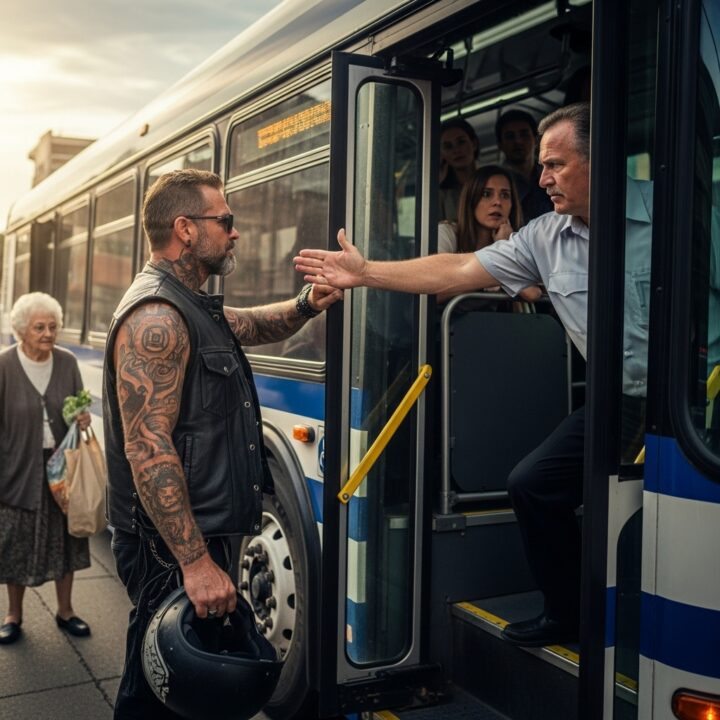
He was in his late forties. Big shoulders. Sleeveless shirt beneath the vest, arms inked with faded tattoos and old scars that told stories only to those who cared to read them. A helmet hung from his fingers. His jaw was set—not in anger, but restraint.
Behind him at the stop stood an elderly woman, bent slightly at the waist, clutching a grocery bag with trembling hands. A teenage boy with headphones watched the scene like it was entertainment. A mother tightened her grip on her daughter’s backpack.
The driver cleared his throat. “Company policy,” he said. “No bulky gear. You’ll have to wait for the next one.”
The biker nodded once. “I can take the back. I’ll stand.”
“No,” the driver replied, firmer now. “You’ll get people nervous.”
That word again. Nervous.
The doors hissed, threatening to close. The biker stepped back onto the curb, boots landing heavy but controlled. The bus doors slid shut with a finality that felt louder than it should have.
Inside, relief rippled. The bus began to inch forward.
Then it stopped.
The engine idled. Loud. Rough. Unmoving.
Passengers exchanged glances. The driver stared straight ahead, hands still on the wheel. He didn’t pull out.
Seconds passed.
The elderly woman at the stop shifted her weight and nearly lost her balance. The biker reached out instinctively, steadying her elbow. She looked up at him, startled, then grateful.
“Thank you,” she whispered.
The driver saw it in the mirror.
He sighed and opened the doors again. “Ma’am, you getting on?”
She nodded. Slowly climbed the steps. The biker stayed back, giving her space.
When she was seated, the driver didn’t close the doors.
He turned in his seat. Looked directly at the biker for the first time.
“Why are you really riding the bus?” he asked.
The question hung there, raw and unexpected.
The biker answered honestly. “Truck’s in the shop. I’m heading to the VA.”
That drew a few looks.
The driver raised an eyebrow. “You a vet?”
“Yes, sir.”
“What branch?”
“Army.”
A pause.
The bus was silent now. No coughing. No phones. Just the low rumble of the engine and the faint hum of fluorescent lights.
The driver nodded slowly. “Still can’t let you on like that.”
The biker didn’t flinch. “I understand.”
He stepped back again.
That should have been the end.
It wasn’t.
From the rear of the bus, a man stood. Early sixties. Cane in one hand, cap pulled low. He walked forward with effort, each step deliberate.
“I don’t,” he said.
The driver frowned. “Sir?”
“I don’t understand,” the man repeated. “Why he’s a problem.”
A murmur moved through the bus.
The man tapped the cane against the floor. “Because he looks like trouble? Because he wears leather?”
The driver tightened his grip on the wheel. “Sir, please sit down.”
The man didn’t. “I served with men who looked like that. Men who stood between me and worse things.”
He turned to the biker. “What unit?”
The biker answered softly. The man nodded, eyes misting.
Another passenger spoke up—a woman in scrubs. “If he stands in the back, what’s the harm?”
A teenager removed his headphones. “Yeah, seriously.”
The driver looked overwhelmed. Rules pressed in from one side. People from the other.
That was when the sound came.
Outside.
Engines.
Low. Respectful. A line of motorcycles rolled up behind the bus, parking neatly along the curb. Riders dismounted one by one. Men and women. Sleeveless shirts. Tattoos. Sunglasses. They didn’t approach the bus. They didn’t stare.
They just stood.
The biker on the curb turned slightly, surprised. One of them nodded to him. That was all.
Inside, the bus went still.
The driver stared at the mirror. Counted. Took a breath.
He shut the engine off.
The sudden silence was shocking.
He stood up.
“I’m not going anywhere,” he said, voice carrying, “until we figure out what kind of people we want to be this morning.”
The doors opened fully.
The biker hesitated. “Sir—”
“Get on,” the driver said. “Back seat. Stand if you want. Or sit. Your call.”
The biker stepped aboard slowly. Removed his helmet. Met the driver’s eyes.
“Thank you.”
The driver nodded. “Don’t thank me yet.”
The biker moved to the back. The elderly woman smiled at him. The man with the cane saluted quietly.
As the biker settled in, one of the riders outside raised a hand in thanks to the driver. No words. No show.
The driver restarted the engine. The bus rolled on.
No one clapped.
They didn’t need to.
Sometimes dignity doesn’t demand a seat.
Sometimes it earns one.
And sometimes, doing the right thing means stopping everything—just long enough to remember who we are.
If this story resonated with you, share your thoughts or a moment when someone stood quietly for what was right in the comments below.