A Little Girl Poured Red Nail Polish Across a Biker’s Silver Beard — The Club Rose in Anger, but He Refused to Wash It Off Until Her Father Walked Out of the Hospital
The little girl emptied red nail polish across Hammer Dawson’s silver beard in a crowded biker clubhouse, and when twenty-three men surged to their feet, the giant biker raised one scarred hand and ordered us not to touch her.
The bottle struck the concrete floor of our clubhouse in Flagstaff, Arizona, bounced beneath Table Nine and rolled in a bright red arc until it stopped against my boot.
Nobody moved after that.
Raymond “Hammer” Dawson sat in the center of the room with lacquer dripping from his beard, staining the collar of his white T-shirt and filling the air with that sharp chemical smell women use at kitchen tables and beauty salons. He was fifty-six years old, six-foot-four, nearly 285 pounds, with a shaved head, tattooed forearms, scarred knuckles and enough prison ink across his shoulders to make strangers reconsider eye contact.
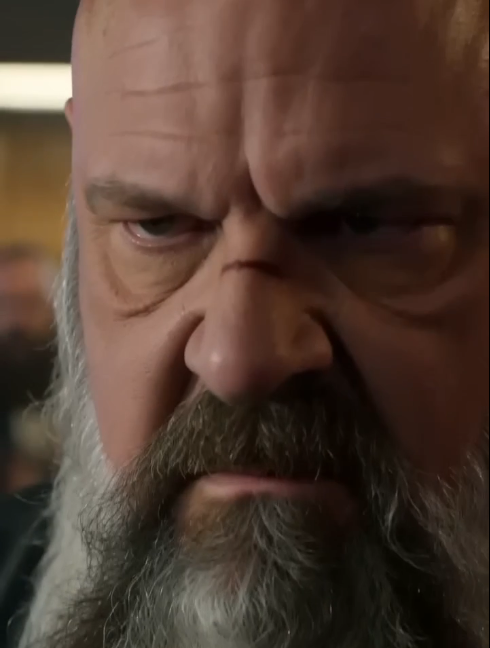
Standing between his boots was an eight-year-old girl named Sophie Mercer.
Her hand still gripped the tiny brush.
“Sixteen,” she whispered.
The word meant nothing to us.
Our road captain, Boone, shoved his chair backward so hard it struck the wall. Two prospects rose beside him. Someone near the bar cursed, and the leather cuts around the room creaked as men who had survived combat, prison and bad highways prepared to protect the oldest member of the Red Valley Riders from a child weighing maybe fifty pounds.
Hammer lifted one finger.
“Sit.”
Every man stopped.
Sophie’s lower lip trembled, but she did not run. She stared at the red liquid spreading through Hammer’s thick silver beard and seemed more frightened by the empty bottle than by the bikers surrounding her.
“I only needed one line,” she said. “I didn’t mean to use all of it.”
Hammer looked down at his ruined shirt. A drop of polish slid from his beard and landed on the back of his tattooed hand.
Then he asked the strangest question I had heard in twenty-seven years of riding beside him.
“Did your daddy open his eyes today?”
Sophie nodded.
“For how long?”
“Almost a minute.”
Hammer leaned back in his chair. “Then sixteen counts.”
None of us understood.
Sophie’s father, Daniel Mercer, had been unconscious at St. Joseph’s Hospital for twenty-one days after his pickup was crushed against a guardrail on Interstate 40. Police called it a single-vehicle accident. The hospital called his condition unstable. Sophie called it sleeping, because every adult around her had failed to find a kinder word.
Hammer had visited Daniel every day.
That was odd enough. Daniel was a county deputy, and Hammer had spent four years inside an Arizona prison after nearly beating a man to death. The two men had argued publicly at a gas station three weeks before the crash. Several people heard Daniel threaten to revoke the club’s charity-ride permit.
Now Daniel could not speak, and Hammer refused to explain why he spent every afternoon beside the deputy’s bed.
The first thin red mark had appeared in Hammer’s beard four days earlier.
Then another.
Then another.
We assumed it was a club joke. Hammer allowed nobody to touch his beard, not even a barber, and once broke a man’s finger for grabbing it during a bar fight.
Yet each evening, Sophie climbed onto a hospital chair, opened that little bottle and painted one narrow red stripe through the silver.
That afternoon, her shaking hand had slipped.
Boone stared at Hammer. “You gonna wash that out?”
“No.”
“It’s all over you.”
“I noticed.”
“We’ve got the veterans’ memorial ride Saturday. Three hundred motorcycles.”
Hammer wiped a red drop from Sophie’s cheek with his thumb. “Then three hundred motorcycles will see it.”
The room stayed silent until Sophie reached inside her backpack and removed a folded hospital bracelet.
Daniel Mercer’s name was printed across it.
On the back, in handwriting that looked nothing like a child’s, were sixteen small red marks and a sentence that made Hammer’s jaw tighten.
I saw only the first four words before he folded it shut.
If I stop waking…
Hammer placed the bracelet inside his vest.
Then he made Sophie a promise in front of all of us.
“I won’t wash out one drop until your father leaves that hospital.”
What we did not know was that Daniel had already awakened long enough to name the man who forced his truck off the highway—and Hammer’s club patch was the last thing he remembered seeing before the crash.
Part 2 — The Biker Outside Room 417
My name is Isaiah Cole, though the Red Valley Riders have called me Preacher since I was twenty-nine. I was the club president when Sophie painted Hammer’s beard, and I was one of the men who nearly stood against her before he silenced us with a finger.
I had known Hammer for twenty-seven years. I knew the number of teeth he had lost in prison, the coffee he ordered after a night ride and the way his left hand shook when thunder sounded too close to the artillery he remembered from Iraq. I knew he carried a silver dollar belonging to his dead wife and kept a photograph of his daughter beneath the tool tray in his garage.
I did not know why he cared about Daniel Mercer.
Three weeks before Sophie spilled the polish, Daniel’s gray pickup had left Interstate 40 east of Flagstaff during a rainstorm. It struck the guardrail, rotated across two lanes and folded around a pine tree below the embankment. The first emergency call came from a trucker who heard the impact but saw only taillights disappearing into the dark.
Hammer reached the wreck before the ambulance.
He told us he had been returning alone from Winslow after delivering a repaired transmission. He saw broken glass beside the highway, stopped his Harley and followed a trail of coolant through the wet weeds.
The pickup’s hood was crushed. Steam rose through the rain. Daniel was trapped behind the steering wheel, and blood ran from his left ear.
Hammer tore the passenger door open with a tow strap attached to the Harley.
That part appeared in the fire department’s report.
The report did not explain why Hammer’s knuckles were split, why Daniel’s service pistol lay thirty feet from the truck or why a strip of black leather had been found tangled in the ruined driver-side mirror.
When Daniel arrived at St. Joseph’s, surgeons repaired internal bleeding and removed pressure from his brain. He survived the first night. Then the second.
He did not wake.
Sophie’s mother had died five years earlier from an aneurysm. Daniel had raised the girl alone after that, learning to braid hair from online videos and packing lunches with notes he pretended came from a fictional kitchen elf. The Mercers had no close family in Arizona, only Daniel’s older sister in Maine and a neighbor who could stay with Sophie for short stretches.
Hammer began sitting outside Room 417 on the third day.
He never entered while Sophie was there. He remained against the hallway wall with his boots planted wide, smelling of motor oil, wet leather and road dust. Nurses asked him to leave twice. Security came once.
Daniel’s captain arrived the next morning and found Hammer still sitting there.
“You waiting for him to die?” Captain Luis Ortega asked.
Hammer looked at the closed door. “Waiting for him to talk.”
“About the wreck?”
“About whatever he wants.”
Ortega knew of their gas-station argument. He also knew Hammer had once been convicted of aggravated assault and that our club had a complicated relationship with county law enforcement.
He told Hammer not to approach Sophie.
Hammer agreed.
Then Sophie approached him.
She found him at the vending machines holding a paper cup of coffee that had gone cold. She asked why his beard was white when his eyebrows were still dark. Hammer said age took strange roads.
She asked whether he was the man who pulled her father from the truck.
Hammer said yes.
Then she asked the question none of us could have answered honestly.
“Did Daddy see you before he went to sleep?”
Hammer crushed the paper cup slightly in his hand.
“He saw somebody.”
“Was he scared?”
“I don’t know.”
“Were you?”
Hammer stared at her.
“Yeah.”
That answer made her trust him.
Children know when adults are building walls out of polite words. Hammer gave her one hard piece of truth, and she sat beside him on the floor.
The first time Daniel opened his eyes happened on the ninth day after the crash. It lasted four seconds. A nurse called his name, his pupils moved toward the sound, and then he disappeared again.
Sophie wanted to mark the day on the wall calendar, but the calendar belonged to the hospital and already carried medical notes. She drew a red line across her own thumbnail instead.
By evening, the line had chipped away.
Hammer found her crying beside the elevator.
“What broke?” he asked.
“My day came off.”
He did not understand until she showed him the nail.
“If it disappears,” Sophie said, “maybe Daddy opening his eyes disappears too.”
Hammer sat on the bench. He thought for a long time before leaning forward and pointing at his beard.
“Put it somewhere harder to lose.”
The next day Daniel opened his eyes for seven seconds.
Sophie painted one red stripe through Hammer’s silver beard.
On the eleventh day, Daniel did not wake. She painted nothing.
On the twelfth, he opened his eyes twice.
She still painted only one line because, in her words, a day should count once.
The ritual continued. Daniel’s better days became red marks. Hammer’s beard became a calendar no nurse could erase, and each stripe dried beneath the cold fluorescent lights while Sophie whispered the number.
What Hammer did not tell me was that he visited after midnight too.
He sat alone beside Daniel’s bed and asked the unconscious deputy the same question every night.
“Who else was on that road?”
By the sixteenth red mark, Daniel had given him an answer.
He raised one shaking hand, caught Hammer’s vest and whispered a road name belonging to one of our own.
“Boone.”
Part 3 — The Name Daniel Whispered
Hammer came to my garage at 2:13 the following morning. Red polish striped his beard from jaw to collar, and the Harley’s V-twin kept ticking outside after he shut it down.
He handed me Daniel’s hospital bracelet.
On the back were sixteen red marks. Beneath them, a nurse had written the sentence Sophie carried into the clubhouse.
If I stop waking, ask what happened at Mile 214.
Daniel had dictated it three words at a time before losing consciousness again.
I read the sentence twice.
Mile 214 was where his pickup went through the guardrail.
“What did he tell you?” I asked.
“Boone.”
The name sat between us like a loaded weapon.
Caleb “Boone” Rourke had been our road captain for eleven years. He was forty-eight, broad through the chest, steady in bad weather and trusted to position every rider from first bike to chase vehicle. He had delivered food after wildfires, slept beside injured brothers in hospitals and carried my wife’s coffin with Hammer.
He was also the man Daniel confronted at the gas station.
Daniel had been investigating thefts from rural construction sites: generators, compressors, copper wire and two utility trailers. A security camera captured a black touring motorcycle near one of the sites. The plate was unreadable, but the rider wore a dark vest with a pale rectangular club patch.
Boone’s Harley matched the shape.
At the gas station, Daniel asked for permission to inspect his saddlebags. Boone refused. Hammer stepped between them before the argument turned physical.
Witnesses remembered Daniel threatening our charity permit.
Nobody remembered Boone leaving first.
“Where is he?” I asked.
“Home.”
“You talk to him?”
“No.”
“Why come to me?”
Hammer placed both palms on my workbench. Red polish glinted beneath the fluorescent tube.
“Because if I go alone, one of us won’t walk away.”
That was as close as Hammer came to admitting fear of his own temper.
I called Boone and ordered him to the clubhouse at sunrise. I did not tell him why.
Then I called the other officers. By six, nineteen members stood in the main room beneath our faded Arizona flag. Coffee burned in the pot. Rain tapped the metal roof. Nobody laughed when Hammer entered with sixteen red marks in his beard.
Boone arrived last.
He saw Hammer, then the bracelet on the table.
His face changed.
Only for a second.
It was enough.
Hammer crossed the room before I could speak. A chair overturned. Boots scraped concrete. Men stepped between them, but Hammer threw two aside and caught Boone by the front of his vest.
“Were you at Mile 214?”
Boone did not answer.
Hammer slammed him against the wall.
“Did you run him off the road?”
“I didn’t touch his truck.”
“Wrong answer.”
I grabbed Hammer’s wrist. Three others locked around his shoulders. The red-striped beard brushed Boone’s face as Hammer leaned close enough to make the threat private.
Boone finally spoke.
“I followed him.”
The room went still.
Daniel had left the gas station after receiving a call about a suspicious utility trailer outside Bellemont. Boone followed because he believed the deputy intended to search a storage unit used by the club.
“What was inside?” I asked.
Boone looked toward the officers gathered behind me.
“Not ours.”
That answer made nothing better.
The storage unit belonged to his younger brother, Wade Rourke, a former club member whose patch we had taken after repeated methamphetamine arrests. Wade still told people he rode with us. He wore an old support vest, imitated our insignia and used Boone’s name whenever a property owner questioned him.
Boone had discovered the stolen equipment two days before Daniel’s crash.
He did not report it.
He planned to move it, sell enough to repay the victims anonymously and force Wade into treatment before police found him. Boone called it protecting his brother.
Daniel called it obstruction.
At Mile 214, Boone rode beside Daniel’s pickup and signaled for him to stop. Daniel refused. Boone accelerated, trying to reach the next exit first.
Then a second motorcycle appeared behind them.
Wade.
He rode close to the pickup’s left side, kicking at the door and shouting through the rain. Daniel swerved away. Wade reached for the driver-side mirror, perhaps trying to frighten him or perhaps trying to pull himself closer.
The mirror tore the leather from Wade’s sleeve.
Daniel’s right tires struck standing water.
The pickup began to rotate.
Boone watched it break through the guardrail.
He stopped fifty yards ahead. Wade did not.
“Why didn’t you call 911?” I asked.
Boone stared at the floor. “I heard Hammer coming.”
“You left a man in a crushed truck.”
“I knew Hammer would stop.”
“You knew?”
His mouth opened, but no answer came.
Hammer released his vest and stepped backward. His hands were shaking so hard that the small silver rings in his beard clicked together.
Nobody had struck Boone.
That almost made the room feel worse.
I removed his road-captain patch.
Our rules required a full vote before expulsion, but I could suspend him immediately. Boone accepted the decision without protest and placed his keys on the table.
Then he told us Wade had returned to the storage unit the previous night.
He had a pickup, stolen plates and enough cash to disappear.
Hammer reached for his helmet.
I blocked the door.
“You’re not hunting him.”
“He left Daniel to die.”
“So did Boone.”
Boone flinched.
Hammer’s stare moved between us.
I knew what he wanted: an address, an engine and ten minutes without witnesses. I also knew what prison had taken from him the first time he mistook rage for justice.
Before I could stop him, the clubhouse door opened.
Sophie stood there holding the red bottle.
Her neighbor had driven her from the hospital because Daniel had awakened again and asked for Hammer.
The twenty-third day had begun.
And the deputy was ready to tell us why he had grabbed Hammer’s vest after the crash—not to accuse him, but to hide something inside it.
Part 4 — What the Deputy Hid in Hammer’s Vest
We rode to St. Joseph’s in silence.
No formation. No pipes rolling for attention. Just four Harleys moving west through thin morning rain, with Hammer leading and Boone following in my pickup because I had taken his motorcycle keys.
Sophie rode with her neighbor.
By the time we reached the hospital, the fresh red lacquer had hardened across Hammer’s beard. Seventeen narrow marks lay beneath the spilled field of crimson, though it was becoming difficult to tell one day from another.
Daniel was awake when we entered Room 417.
He looked smaller than the man I remembered directing traffic at our toy rides. Tubes ran beneath his hospital gown. One side of his face sagged slightly, and his left hand moved only when he concentrated.
His eyes found Boone first.
Boone stopped at the door.
“I’m sorry,” he said.
Daniel’s throat worked around the words. “Not enough.”
“No.”
It was the first honest thing Boone had said.
Captain Ortega stood beside the window with a recorder, but Daniel refused to begin until Sophie was taken to the cafeteria. She argued. Hammer promised to stay, so she finally left with the neighbor.
Daniel told the story in fragments.
He confirmed Boone had followed him from the gas station. He confirmed Wade had ridden beside his truck and grabbed the mirror. But neither motorcycle had struck the pickup.
The hydroplaning caused the crash.
That distinction mattered legally.
It did not absolve either brother.
Daniel remembered the truck falling through the guardrail, the windshield breaking and a hard silence after the engine stopped. He smelled gasoline. He heard water dripping onto hot metal.
Then came the Harley.
Hammer climbed down the slope, tore at the passenger door and crawled into broken glass. Daniel believed the leaking fuel would ignite. He could not feel his legs, and every breath produced a hot tearing pain beneath his ribs.
He gave Hammer his service pistol because he feared rescuers might mistake it for a threat.
Hammer threw it into the grass.
Then Daniel saw Wade above the embankment.
Wade had returned on foot.
He stood behind the guardrail watching Hammer work. When Daniel looked directly at him, Wade raised one finger to his lips.
Daniel tried to say his name.
Blood filled his mouth.
Hammer leaned close, and Daniel grabbed the biker’s vest. His fingers found the inner pocket. Wade’s torn strip of leather was clenched in his hand, caught there when the mirror broke.
Daniel pushed it inside Hammer’s vest.
“He saw me,” Daniel whispered. “Wade saw.”
Hammer’s face hardened.
Wade had not returned to help. He returned to recover the evidence. When he saw Hammer below, he waited until sirens approached and fled.
Hammer never discovered the leather because paramedics cut his vest off after he collapsed from smoke inhalation beside the ambulance. The hospital placed it in a plastic belongings bag.
Sophie took the bag home by mistake with Daniel’s property.
That was why Daniel had written the message about Mile 214.
The evidence might still exist.
Captain Ortega drove Sophie’s neighbor to the Mercer house. Inside Daniel’s hall closet, they found Hammer’s vest folded beneath a winter coat. The inner lining had been cut.
The leather strip was gone.
Someone had entered the house.
Boone sank into the visitor chair.
“Wade has a key,” he said.
Daniel stared at him. “You gave it?”
“Months ago. When I fixed Sophie’s bedroom window.”
Ortega called officers to Wade’s storage unit and apartment. Both locations were empty.
The stolen equipment was gone.
So was Wade.
Then Daniel said something that turned the room toward Hammer.
“Red truck.”
Hammer looked at me.
“What red truck?” I asked.
“Wreck,” Daniel said. “Before mine.”
Six years earlier, Hammer’s daughter, Emily Dawson, died when a red pickup struck her car outside Winslow and left the scene. She was twenty-six, a middle-school art teacher and the mother of a four-year-old boy Hammer had not been allowed to see after her death.
The case remained unsolved.
A witness remembered a motorcycle loaded in the pickup bed. The rear plate had been covered in mud.
Hammer kept the original police bulletin in his garage.
Daniel had reopened the file four months before his own crash after finding a repair invoice for Wade’s red Ford. The date was two days after Emily died. The invoice listed damage to the right headlight, grille and hood.
Wade told police he struck a deer.
Boone closed his eyes.
He had repaired the motorcycle in the truck bed that same week. Its front wheel was bent. Wade claimed he dropped it unloading.
“You knew?” Hammer asked.
“Not about Emily.”
“Did you ask?”
Boone said nothing.
Hammer’s breathing changed. I heard the leather of his gloves tighten as his fists closed.
Daniel tried to lift his hand.
“Don’t.”
Hammer turned toward the bed.
“Don’t give him prison too,” Daniel whispered.
The sentence was not mercy for Wade.
It was protection for Hammer.
Daniel had spent months investigating the red pickup quietly because he knew what Hammer would do if he learned too soon. Their argument at the gas station had been staged. Daniel publicly threatened our permit so Wade would believe the deputy was targeting the club over stolen equipment, not examining an old fatal collision.
Daniel was getting close.
That was why Wade followed him.
Hammer looked at the red polish in his beard. For the first time, I understood what those marks were holding in place. They were not only Sophie’s record of her father waking.
They were a fence around Hammer’s anger.
As long as Daniel remained in the hospital, Hammer had promised Sophie he would wear the red.
And as long as he wore it, every mirror showed him the person who needed him to come back without blood on his hands.
Part 5 — The Ride That Chose Not to Become a Hunt
Wade’s abandoned red Ford was found outside Kingman that afternoon. Its plates had been removed, the interior wiped clean and a motorcycle ramp left in the bed.
Police believed he had crossed into Nevada.
Hammer disappeared from St. Joseph’s before sunset.
His Harley was gone. So were the cash roll from his saddlebag, a road atlas and the photograph of Emily he carried behind his license.
I called every member of the Red Valley Riders.
Nobody claimed to know where he was.
That meant at least three were lying.
Our brotherhood had failed once already by letting Boone place blood loyalty above the truth. Now some members believed Hammer deserved ten minutes alone with Wade before police arrived.
They called it justice.
I remembered the four years Hammer spent in prison. I remembered Emily visiting him behind glass when she was twelve, asking why her father could not come home. Hammer had told her he made a bad choice.
He had spent the rest of her life trying to become a man whose choices did not leave her waiting.
I would not let her death send him back.
We found his route through a gas receipt from Seligman. Hammer was heading west on Interstate 40, following a message Wade had sent from a disposable phone.
Come alone if you want the truth about Emily.
Six of us rode after him.
Boone came too.
I told him he had no patch, no position and no right to wear our colors. He removed his vest and rode in a plain gray jacket.
“Why are you here?” I asked.
“Because I kept Wade’s secrets until they became everybody’s graves.”
Near Needles, California, the desert wind carried heat even after dark. Hammer’s taillight appeared ahead of us at an abandoned service station beside the old highway.
Wade waited beneath the collapsed canopy.
His motorcycle stood beside him, loaded with two bags. A handgun rested on the concrete near his boot, not raised but close enough to change every breath.
Hammer had already dismounted.
He wore no helmet. His beard shone dark red in the station’s broken light.
Wade laughed when he saw it.
“What happened to you?”
Hammer kept walking.
Wade’s smile faded. “Stop.”
Hammer did not.
Boone rode past us and positioned his motorcycle between the two men. He killed the engine, removed his helmet and stood facing his younger brother.
“Move,” Hammer said.
“No.”
Wade pointed toward the other bikers arriving behind me. “He told you to come alone.”
“I did,” Hammer said. “They don’t listen.”
It was the closest thing to humor in that desert, but nobody smiled.
Wade began talking fast. He insisted Emily’s collision had been an accident. She stopped suddenly. Rain obscured the road. He panicked because he had drugs in the truck and a stolen motorcycle in the bed.
He said he returned ten minutes later.
Her car was already surrounded by people.
He told himself leaving made no difference.
Hammer stopped five feet away.
“Did she move?”
Wade swallowed.
“When you saw her,” Hammer said, “was she moving?”
Wade looked at Boone.
That was the answer.
She had been alive.
Emergency records showed the first 911 call came eighteen minutes after impact. A passerby found her. Wade could have called sooner, could have pulled her from the smoking car or could simply have stayed and spoken her name.
Instead, he drove away.
Hammer moved.
Boone caught him around the chest. They struck the motorcycle, knocking it sideways. Wade reached toward the handgun.
I kicked it beneath a rusted vending machine.
The others restrained Wade while Hammer threw Boone onto the concrete and tried to reach him. He did not shout. That frightened me more. Rage had emptied his face of everything except purpose.
Then a small voice came through my phone.
“Seventeen.”
Sophie had called.
I must have answered without realizing it during the struggle. She was at Daniel’s bedside, waiting to paint the day’s mark, but Hammer was gone.
“Mr. Hammer,” she said through the speaker, “Daddy opened his eyes again. You need another line.”
Hammer froze.
Boone still held one arm. I had the other.
Sophie continued, unaware of where we were.
“He asked for you. He said not to make me lose a day.”
The desert went quiet except for hot engines ticking beneath us.
Hammer looked at Wade.
Then he looked at the red beard hanging over his chest.
“Put Ortega on,” he told me.
Captain Ortega documented Wade’s location, contacted California authorities and stayed on the line until sirens sounded from the highway. Wade was arrested without Hammer touching him.
Boone sat beside the fallen motorcycle, blood running from his lower lip.
Hammer extended one hand and pulled him up.
That was not forgiveness.
It was a choice.
We rode back east before sunrise. At a truck stop outside Lake Havasu City, Hammer entered the women’s cosmetics aisle wearing road dust, black leather and a beard stained the color of a warning light.
He bought another bottle of red nail polish.
The cashier stared at him.
Hammer placed exact change on the counter.
“Missed a day,” he said.
Part 6 — Forty-Seven Red Marks
Daniel remained hospitalized for another month.
Recovery did not arrive cleanly. Some mornings he recognized everyone. Other mornings, he forgot why his left side would not obey him. He developed pneumonia, returned to intensive care for three days and frightened Sophie so badly that she stopped bringing the polish.
Hammer kept visiting.
On the morning Daniel opened his eyes after the pneumonia, Hammer set the new bottle beside Sophie’s hand.
“You count the day,” he said. “Not the fear.”
She painted mark eighteen.
By mark twenty-five, Daniel could speak complete sentences. At mark thirty-one, he sat upright without assistance. At mark thirty-eight, he stood between parallel bars while a therapist steadied his waist.
Hammer watched from the doorway.
His beard had become almost completely red. Silver remained only near the roots, growing outward beneath the lacquer. Nurses began calling him Santa’s dangerous cousin. Children from the pediatric floor asked whether he was a pirate.
He answered every question with a grunt.
The veterans’ memorial ride happened while Daniel was still in rehabilitation. Boone had always planned the route, but his suspension remained in place, so I led three hundred motorcycles through downtown Flagstaff.
Hammer rode beside me.
He could have covered his beard with a bandanna. He did not.
People along the road photographed the massive tattooed biker with crimson whiskers. Some laughed. Some pointed. At the veterans’ cemetery, Hammer removed his helmet and stood before the graves exactly as he was.
Boone attended without colors. He stood at the rear.
Afterward, he handed Captain Ortega financial records, storage addresses and the names of everyone who had purchased Wade’s stolen equipment. He sold his Harley to repay two victims whose property could not be recovered.
The club voted to expel him.
Hammer voted against it.
Not because Boone was innocent. He was not. Hammer argued that taking his patch would let him leave before repairing anything.
The final decision suspended Boone for two years and required restitution, testimony and service on every charity event without wearing club colors.
“You sure?” I asked Hammer.
“No,” he said. “Do it anyway.”
Wade later pleaded guilty to leaving the scene of Emily’s collision, evidence tampering, possession of stolen property and reckless driving connected to Daniel’s crash. He never apologized to Hammer.
Hammer never asked him to.
Forty-six days after the first red mark, Daniel walked twelve steps with a cane.
On day forty-seven, the hospital signed his discharge papers.
Sophie arrived wearing a red dress beneath her winter coat. Our entire club waited outside the rehabilitation entrance with engines silent. Nurses crowded the windows. Captain Ortega stood beside Daniel’s wheelchair, though Daniel refused to remain seated once he reached the doors.
Hammer waited at the curb.
His beard was a stiff, uneven mass of dark crimson, chipped at the tips and silver underneath. Sophie held nail-polish remover and a bag of cotton pads.
“You can clean it now,” she said.
Hammer looked at Daniel.
The deputy placed both hands on his cane and took one step through the doorway.
Then another.
Hammer shook his head. “Not out yet.”
Daniel cursed at him softly and continued.
The final ten feet took almost four minutes.
Nobody started an engine. Nobody spoke.
When both Daniel’s shoes reached the sidewalk, Sophie opened the remover.
Hammer stopped her.
“Leave one.”
She cleaned the red from his beard slowly, exposing silver beneath forty-seven days of fear, anger and promises. Near his right cheek, she left one narrow crimson stripe.
Hammer wore it home.
Part 7 — The Stripe That Stayed
Daniel never returned to patrol duty.
He spent another year in physical therapy, then accepted a position training new deputies in crash response and victim communication. His left hand remained weak, and he walked with a cane when the weather turned cold.
Sophie no longer called unconsciousness sleeping.
She also stopped needing calendars to prove good days had happened.
Hammer became part of their life without anyone naming what he was. He repaired their porch step, attended school conferences when Daniel could not drive and waited outside Sophie’s dance recital because he believed men dressed like him did not belong near pink curtains.
Sophie dragged him inside.
Boone completed his two-year suspension. When the club voted on restoring his patch, Daniel attended the meeting. He did not speak for Boone or against him.
Boone spoke for himself.
“I protected my brother from consequences,” he said, “until consequences reached everybody else.”
We returned his patch without restoring his road-captain position.
Hammer shook his hand.
Nothing more.
Every year on the anniversary of Daniel’s discharge, Sophie paints one narrow red stripe into Hammer’s beard. By her thirteenth birthday, the silver had turned almost white, but that line remained bright enough to see from across the clubhouse.
The original bottle sits inside a small glass case above Table Nine.
Beside it is Daniel’s hospital bracelet with forty-seven red marks across the back. The unfinished sentence remains visible beneath them.
If I stop waking…
Sophie eventually completed it in her own handwriting.
…someone else will remember the days for me.
Hammer pretends he never reads those words.
I have seen him stand beneath the case after everyone leaves, one scarred hand resting on the chair where Sophie once stood between his boots. He stays until the coffee goes cold and the clubhouse settles into silence.
Then he walks outside.
The Harley starts with that deep, uneven thunder you feel through concrete before you hear it. Daniel waits at the curb with his cane. Sophie climbs into the sidecar, now too old to need help but still willing to take Hammer’s hand.
One silver beard.
One red stripe.
One promise that survived the hospital doors.
Follow our page for more unforgettable biker stories about misunderstood riders, tested brotherhood and the quiet promises hidden beneath leather, scars and roaring engines.