The Biker Was Accused of Causing Trouble in Church — Until the Priest Stepped Outside
The shouting didn’t start inside the church—it started on the steps, when a biker stood still while everyone else decided he didn’t belong there.
Sunday morning. A small church in the American Midwest. White wooden doors. Faded stone steps worn smooth by decades of quiet faith. The kind of place where people greet each other by first name and notice when someone new shows up.
That morning, the air was tense before anyone could explain why.
A young woman stood near the entrance, clutching her purse too tightly. Her eyes darted between the doors and the man at the bottom of the steps. An elderly usher whispered urgently into his phone. A few congregants slowed their walk, pretending to fix coats or shoes while watching from the corner of their eyes.
At the bottom of the steps stood the biker.
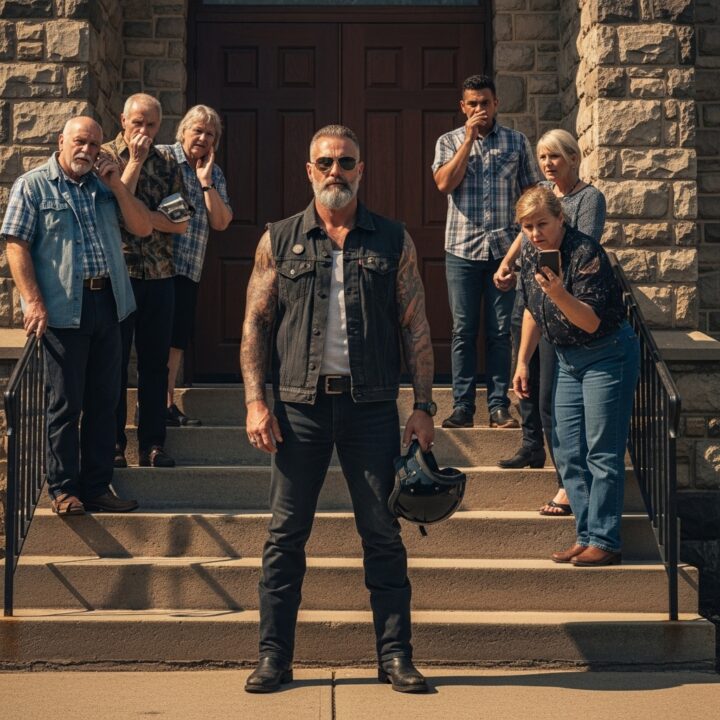
Black motorcycle parked at the curb. Engine already off. Helmet tucked under one arm. Sleeveless denim vest over a dark shirt. Tattoos climbing both forearms like old road maps. A figure that disrupted the symmetry of pressed suits and Sunday dresses.
He wasn’t shouting.
He wasn’t blocking the door.
He wasn’t moving at all.
But fear doesn’t need motion.
Someone whispered, “He’s causing trouble.”
Another said, “I don’t feel safe with him here.”
A third muttered, “Why would someone like that come to church?”
The biker lifted his eyes once—slow, steady—then lowered them again.
The bells stopped ringing.
The usher finally stepped forward. Nervous smile. Hands shaking.
“Sir,” he said, trying to sound firm, “you can’t stay here like this.”
The biker didn’t argue. He shifted his weight slightly, boots scraping stone. A small movement that looked bigger than it was.
That was enough.
A woman gasped. Someone pulled a phone from a pocket. Another man stepped between the biker and the doors, chest puffed, voice raised. “You need to leave. Now.”
The biker exhaled slowly. “I’m not here to cause problems.”
But his voice was low. Calm. Almost swallowed by the rising noise.
To the crowd, it sounded like a threat disguised as restraint.
“Call security.”
“Call the police.”
“Why is he even here?”
The biker raised one hand—not in defense, not in surrender. Just enough to signal he heard them. The gesture was misread instantly.
A child peeked from behind her mother’s coat, eyes wide. The young woman by the door began to cry quietly, overwhelmed by the attention she didn’t want.
The biker stepped back half a pace. Gave space. Offered nothing that looked like apology.
Silence fell, thick and unstable.
Someone dialed 911.
The situation tightened fast.
The biker was now alone at the base of the steps, ringed by judgment but not by courage. A circle of people close enough to accuse, far enough to avoid responsibility.
The young woman near the door sank onto the steps, trembling. Whatever had brought her here was already heavy enough. Now it was being buried under suspicion and noise.
The biker noticed her first.
He took off his helmet and set it on the ground. Slowly. Carefully. As if loud movements might shatter something fragile in the air.
That made it worse.
“Don’t put things down like that,” someone snapped.
“Sir, keep your hands where we can see them.”
The biker straightened, hands visible, palms open. A posture learned somewhere that didn’t offer second chances.
He pulled out his phone.
Not angrily. Not dramatically.
Typed one message.
Raised it to his ear.
“I’m outside,” he said. “Yeah. By the steps.”
He listened.
“No, it’s fine. I’ll wait.”
He ended the call and slipped the phone back into his pocket.
No one knew who he’d contacted.
No one liked the waiting.
The sirens hadn’t arrived yet, but they felt close enough to hear.
Inside the church, the sermon paused.
Outside, everything hovered on the edge of becoming something no one would be proud of later.
The door opened.
Not suddenly. Not violently.
Just enough to let a voice out.
“Hold on.”
The priest stepped into the sunlight.
Late 60s. Thin frame. White collar slightly crooked. A man whose authority came from calm, not volume.
He looked at the crowd first. Then at the biker.
His expression didn’t harden.
It softened.
“Michael,” the priest said, using a name no one else had spoken. “You made it.”
The air shifted.
The biker nodded once. Respectful. Silent.
The priest descended the steps slowly, each footfall deliberate. The sound of leather shoes on stone cut cleaner than any shout.
“What’s going on?” he asked, though he already knew.
Someone rushed to explain. Words spilled out—fear, assumptions, accusations stacked carelessly together. The priest listened without interrupting.
Then he turned to the biker.
“You okay?” he asked.
“Yes, Father.”
Two words. No defense. No bitterness.
The priest turned back to the crowd. “This man isn’t causing trouble.”
A pause.
“He’s here because I asked him to come.”
No one spoke.
Somewhere down the street, engines rolled in—motorcycles, arriving one by one. They parked quietly. Riders dismounted with the same restraint. No formation. No threat. Just presence.
The police car slowed, then passed.
The truth emerged without ceremony.
The biker was a veteran. Former military police. Now part of a group that quietly escorted people who were afraid to walk alone. Abuse survivors. Grieving families. Those who needed someone solid nearby without being asked questions.
The young woman on the steps had lost her husband two weeks earlier. He had been buried on Friday. Church felt impossible alone.
So the priest made a call.
No announcement had been planned. No attention requested.
But attention arrived anyway.
The people who had judged first now stood unsure where to look. Some stared at the ground. Others folded hands that trembled just slightly.
The biker picked up his helmet.
“Sorry for the disruption,” he said—not loud, not dramatic.
The priest shook his head. “You didn’t disrupt anything that mattered.”
They walked inside together. No applause. No explanations.
Later, when the service ended, the biker left first. Same quiet steps. Same steady pace.
He mounted his bike, paused once, and adjusted his mirror. In the reflection, the church doors stood open, sunlight spilling out.
He rode away without looking back.
What stayed behind wasn’t a lesson spoken aloud—but the uncomfortable echo of how easily fear fills silence, and how courage sometimes looks like standing still while the world misunderstands you.
No hero.
No villain.
Just a moment that felt real enough to linger.