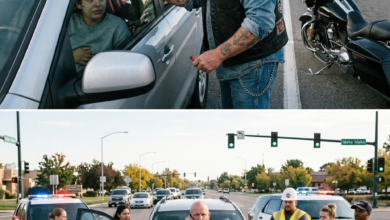
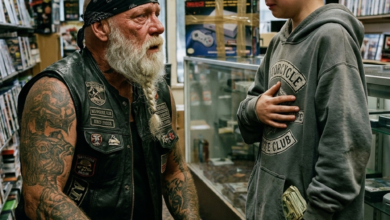
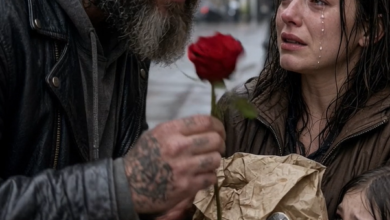
A 7-Year-Old Walked Into A Biker Bar With $11 In Change And Asked To Rent A Dad For One Day — When They Asked His Father’s Name, The Whole Bar Stood Up
Part 2
Before Ike Dalton was a club president, before he owned a bar, before he had a single gray hair, he was an eighteen-year-old punk with a juvenile record and nowhere to go.
Summer of 1990. Springfield, Missouri.
His father was gone. His mother worked nights at the Kraft plant and slept days. He’d been kicked out of Central High his junior year for fighting. He’d done six months at the juvenile center on Division Street for stealing a car he couldn’t even drive right.
When he got out, he was angry at everything.
He worked a summer job hauling sod for a landscaper. Saved every dollar. Eight hundred dollars.
And he bought a motorcycle.
A 1979 Harley Sportster. Rusted. Smoking. The seller in Republic swore it ran fine. It ran fine for exactly four days.
On the fifth day, a Saturday in August, Ike was riding it east on Route 66 through the middle of Springfield when the engine coughed, sputtered, and died in front of a used tire lot on College Street.
It started to rain.
Ike stood on the side of the road in a downpour next to a dead motorcycle and kicked it. Then he kicked it again. Then he sat down on the curb in the rain and put his head in his hands.
Eighteen years old. Eight hundred dollars gone. No money to fix it. No way to get it home. Nobody to call.
A beat-up blue Ford pickup pulled over behind him.
A man got out.
Thirty, maybe. Thin. Grease under his fingernails. A navy work shirt with a name patch over the pocket. FRANK.
He looked at the bike. He looked at the kid sitting on the curb.
“Carburetor or electrical?” he said.
“I don’t know,” Ike said. “I don’t know anything about it.”
Frank nodded.
“Help me get it in the truck.”
Frank Lang owned a two-bay garage on Commercial Street, the old part of town by the railroad tracks. LANG’S GARAGE, EST. 1985, painted by hand on the brick.
He kept that Sportster for two days.
He rebuilt the carburetor. He replaced the plugs and the wires. He found a cracked fuel line and a bad coil. He adjusted the chain. He changed the oil, which had never been changed, as far as he could tell.
Ike hung around the whole time. Frank didn’t ask him to. Didn’t tell him to leave. Just started handing him tools.
“That’s a nine-sixteenths.”
“That’s a feeler gauge.”
“Hold this.”
By the end of the second day, Ike had learned more about engines than he’d learned in eleven years of school.
On Monday afternoon, Frank wiped his hands on a rag and turned the key.
The Sportster fired up on the first kick. Clean. Steady. Purring.
Ike stood there and grinned like an idiot.
Then he pulled a wad of cash out of his pocket. Sixty-three dollars. Everything he had left.
“How much do I owe you?”
Frank looked at the money.
Then he looked at Ike. At the juvenile tattoo on his hand. At his hard face. At his chewed fingernails.
“Put it away,” Frank said.
“I gotta pay you.”
“No, you don’t.”
“Why not?”
Frank was quiet for a minute. He looked at the motorcycle. Then back at the kid.
“Bikes, anybody can fix,” he said. “People are harder.”
He handed Ike the keys.
“Go do something with yourself.”
Ike rode away.
He thought about that sentence every day for a year.
Then every week. Then every month.
He got a job at a Harley dealership on the north side, sweeping floors. Then as a mechanic’s helper. Then a mechanic. He never got arrested again. He married a girl named Shawna in 1996. They had three kids. He joined the Queen City Riders in 1998. He bought the Rusty Spoke in 2007.
He kept the Sportster.
It sits on a stand behind the bar at the Rusty Spoke to this day. Polished. Running. Ike starts it once a month.
On the carburetor cover, scratched into the chrome with the tip of a screwdriver, small and neat, are two letters.
F.L.
Frank put them there that day. A mechanic’s mark. Ike had never sanded them off. Never wanted to.
He went back to Lang’s Garage a few times over the years. Brought his bike in for service. Brought donuts. Frank always waved him off.
Then, sometime around 2010, the garage closed. A sign in the window said RETIRED — THANKS FOR 25 YEARS. Ike figured Frank moved to the lake. Or Branson. He meant to look him up.
He never did.
Life got busy. The way it does.
Part 3
“Frank Lang,” Theo said. “His name was Frank Lang.”
Ike stood behind the bar with his back against the cooler and couldn’t breathe.
“Frank,” he said. “Lang’s Garage? On Commercial Street?”
Theo nodded. “He fixed cars. And motorcycles. Mommy says he could fix anything.”
The old-timers at the end of the bar had gone completely still.
One of them, a man named Earl Briggs, seventy-one, a charter member, put his beer down.
“Frank Lang died?” Earl said. “When?”
“Two years ago,” Theo said. “In the hospital. He had cancer in his tummy.”
Earl closed his eyes.
But Ike couldn’t think about that yet. He couldn’t let himself. Not with a seven-year-old standing in his bar alone.
He made himself focus.
“Theo,” he said. “Does your mom know where you are? Did you tell anybody?”
Theo shook his head. Looked at the floor.
“I told Grandma I was going to Mason’s house. Mason lives across the street. But I walked to the bus stop instead.”
“Where’d you get the address for this place?”
Theo dug in his pocket and pulled out a folded piece of paper. Bright orange. Wrinkled. He smoothed it on the bar.
A flyer. From last December. QUEEN CITY RIDERS ANNUAL TOY RUN — BRING A TOY, FEED A KID. Staging at THE RUSTY SPOKE, 4120 W. Route 66.
“It was on the board at the grocery store,” Theo said. “It had motorcycles on it. Daddy liked motorcycles.”
He looked up.
“I thought maybe motorcycle people would know how to be a dad.”
Somebody behind Ike made a sound. Ike didn’t turn around to see who.
The bar phone rang.
Ike grabbed it.
“This is Carrie Lang,” a woman’s voice said. Frantic. Breathless. “You left a message about my son? Is he okay? Is Theo okay?”
“He’s fine, ma’am,” Ike said. “He’s sitting right here. He’s safe. Nobody’s going anywhere. He’s got a glass of chocolate milk and about eleven grown men babysitting him.”
He heard her start to cry on the other end of the line.
“I’m at work,” she said. “At the pharmacy. On Battlefield. I’m coming right now. Please don’t let him leave.”
“He’s not going anywhere, ma’am,” Ike said. “Take your time. Drive safe.”
He hung up.
Theo was watching him.
“Is Mommy mad?”
“She’s scared, partner. Because she loves you. That’s a different thing.”
Theo nodded slowly.
Then he looked back at the eleven dollars on the bar.
“So,” he said, very quietly. “Can I rent one?”
Ike didn’t answer right away.
He wanted to say yes. Every bone in his body wanted to say yes.
But he was fifty-four years old and he’d lived in this world a long time. He knew how it looked. A biker from a bar showing up at an elementary school with a seven-year-old he’d known for twenty minutes. Teachers. Principals. Parents. Rules. He couldn’t just say yes.
Not without his mother. Not without doing it right.
Theo saw him hesitate.
And his face fell. Just collapsed. All that bravery, all that forty minutes on a bus, all those quarters stacked in little towers.
“It’s okay,” Theo said. His voice cracked. “It’s okay. It’s not enough money. I know.”
He started scooping the coins back into the sandwich bag.
Part 4
Ike put his hand over the coins.
Gently. His big tattooed hand flat on top of that little pile of quarters.
“Theo,” he said. “Stop.”
The boy stopped.
“I want you to come with me for a second.”
He came around the bar. He held out his hand.
Theo took it. His small hand disappeared inside Ike’s.
Ike walked him to the back of the bar. Past the pool tables. Past the jukebox. To the corner, where a motorcycle sat on a chrome stand under a spotlight.
A 1979 Harley Sportster. Black tank. Polished chrome. A little rust on the fender that Ike had never wanted to fix.
“You know what this is?”
Theo shook his head.
“This is the first motorcycle I ever owned,” Ike said. “I bought it when I was eighteen. It broke down on the side of the road in the rain. I was sitting on the curb, crying, because I didn’t have any money to fix it.”
Theo looked up at him.
“You cried?”
“Like a baby.”
Theo almost smiled.
“A man pulled over in a blue truck,” Ike said. “He put my bike in the back. He took it to his garage. He fixed it for two days. Taught me everything about it.”
He crouched down next to the Sportster. He pointed at the chrome carburetor cover.
“And when he was done, he scratched his initials right here. See?”
Theo leaned in.
F.L.
“F,” Theo read slowly. “L.”
“When I tried to pay him,” Ike said, “he wouldn’t take it. Not one dollar. He told me something. Something I’ve thought about every single day for thirty-six years.”
His voice broke. He didn’t care.
“He said, bikes, anybody can fix. People are harder.”
Theo stared at the letters.
“His name was Frank Lang,” Ike said. “Your daddy fixed my motorcycle. And then he fixed me.”
Behind them, Ike heard a chair scrape.
Then another.
He turned around.
Earl Briggs was standing up at the end of the bar.
Then Tater, by the pool table. Then the two old guys arguing about the Chiefs. Then the cook, from the kitchen door. Then every man in the Rusty Spoke.
Twelve men in leather. On their feet.
Earl’s voice was rough.
“Frank Lang did my brakes in 1994 when I was out of work,” he said. “Wouldn’t take a dime.”
“Rebuilt my transmission in ’02,” said a man named Dewayne. “Charged me for the parts. Not the labor.”
“Fixed my daughter’s car the day before her wedding,” said another. “Came in on a Sunday. Wouldn’t let me pay him either.”
Theo looked from one face to another. His mouth open.
“Daddy fixed all your stuff?”
“Your daddy,” Earl said, “fixed half the motorcycles in this county. And he never told a single soul.”
Ike knelt down in front of Theo.
“He never told you?” he asked. “Or your mom?”
Theo shook his head.
“He didn’t talk about work much. Mommy said he liked to fix things quiet.”
That was Frank.
Never once in thirty-six years had Ike heard him mention a favor. Not to brag. Not to collect. Not to anybody.
He just fixed things. Then sent people on their way.
Theo’s mother came through the front door twenty minutes later.
Forty-one. Pharmacy scrubs. Her name tag still clipped on. CARRIE. Her face was white. Her car keys were still in her hand.
She saw her son sitting on a barstool in the middle of a biker bar, drinking chocolate milk, with twelve grown men in leather standing around him.
She dropped her keys.
Theo jumped off the stool and ran to her.
“Mommy! Mommy! Daddy fixed his motorcycle! Daddy fixed EVERYBODY’S motorcycle!”
Carrie held him. She looked over his head at Ike. Confused. Terrified. Exhausted.
Ike walked over. He held out his hand.
“Ma’am. I’m Ike Dalton. I’m so sorry for scaring you. And I’m so sorry about Frank.”
She looked at his hand.
“You knew Frank?”
Ike told her. All of it. The rain. The curb. The truck. The garage. The sentence.
She didn’t say anything for a long time.
Then she put her hand over her mouth.
“He never told me,” she whispered. “Twelve years of marriage. He never told me any of this.”
She looked at the Sportster under the spotlight. The two letters on the chrome.
She started to cry.
Ike gave her the first barstool. Earl brought her a glass of water. Tater went and found a box of tissues behind the bar that nobody had touched since 2016.
Part 5
Carrie told Ike the rest, sitting at the bar with Theo in her lap.
She met Frank in 2012. He was fifty-two. She was twenty-nine. He’d retired from the garage two years earlier and was doing odd repair jobs out of his own garage at home. She’d brought her car in with a strange noise. He fixed it in ten minutes and wouldn’t let her pay.
She brought him a pie as a thank-you.
They were married a year later.
Theo came along in 2018. A surprise. Frank was fifty-eight.
“He was so scared,” Carrie said, smiling. “He kept saying he was too old. He said, What if I’m not around long enough?”
Her smile went away.
He was diagnosed with pancreatic cancer in the spring of 2023. Theo was five.
He died that October.
“He kept working,” Carrie said. “Right up until the end. Even when he could barely stand up. Neighbors would bring their lawnmowers. He’d sit in a lawn chair in the garage and talk them through it.”
She looked at Theo.
“He made Theo a little tool set. Plastic. Before he got too sick. Theo carries the screwdriver in his backpack every day.”
Theo nodded seriously.
He reached into his pocket. He pulled out a small red plastic screwdriver. Worn white at the handle.
He held it up to Ike.
“It’s Daddy’s,” he said.
Ike looked at it for a long time.
Then he asked Carrie the question he’d been holding.
“Ma’am. About Saturday.”
Carrie went still.
“He told me about Donuts with Dad,” she said. “Weeks ago. I told him I’d go with him. He said no. He said the flyer said dads. He said everybody would look at him.”
She swallowed.
“Then his teacher asked him in front of the class. Who’s coming with you, Theo? Three times. Over three days. She didn’t mean anything by it. She just didn’t think.”
Carrie wiped her eyes.
“He came home and stopped talking for two days.”
Theo had his face buried in his mother’s shoulder now.
Ike looked at the eleven dollars still stacked on the bar.
“Carrie,” he said. “I’d like to go with him. If you’ll let me. If the school will let me. We’ll do it right. Background checks. Whatever they need. You’ll be there too. Every step.”
Carrie looked at him.
The big biker with the gray beard and the Route 66 tattoo and the juvenile ink on his hand.
The kid Frank pulled off the curb in the rain.
“Frank would’ve liked that,” she said.
Then Earl Briggs cleared his throat at the end of the bar.
“Ike,” he said. “Just you?”
Ike turned around.
Every man in the Rusty Spoke was still standing.
They did it right.
On Wednesday morning, Ike and Carrie sat in the principal’s office at Pickwick Elementary on the south side of Springfield. The principal, a gentle woman named Dr. Sandra Kemp, listened to the whole thing with her hand over her mouth.
Then she brought in Theo’s teacher. Mrs. Ellen Petrie. Fifty-six. Twenty-eight years in first grade.
When she heard what Theo had done, what he’d said, why, she put her face in her hands.
“I asked him three times,” she said. “I just wanted to make sure he had somebody. I didn’t think. I didn’t think about how it felt.”
She looked at Carrie.
“I’m so sorry.”
Dr. Kemp made one phone call to the school district’s volunteer office. Every visitor at a school event in Springfield Public Schools already had to be cleared. Background check. Fingerprints. A sign-in at the front office.
By Friday afternoon, twenty-two members of the Queen City Riders had been fingerprinted, run, and cleared as approved school volunteers.
Every one of them passed.
Even Earl.
On Friday night, Shawna Dalton, Ike’s wife, stayed up until two in the morning at her sewing machine.
She was making a vest.
A tiny one. Black leather. Soft. Child-sized. With a small Queen City Riders patch on the front.
And on the back, where a member’s colors would go, she stitched something else.
A patch she’d designed herself that afternoon from an old photo Carrie gave her.
A hand-painted brick sign.
LANG’S GARAGE — EST. 1985.
Part 6
Saturday morning. Eight o’clock. Pickwick Elementary.
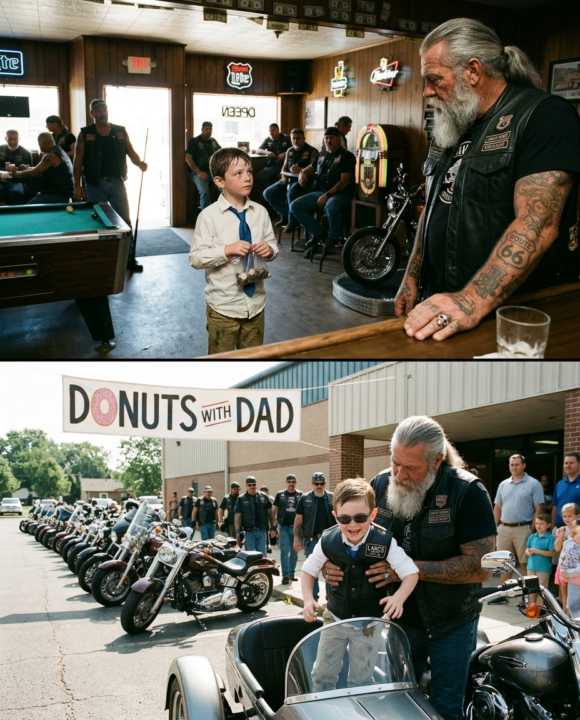
The parking lot was full of minivans. Dads in polo shirts and ball caps. Kids running around the playground. Boxes of donuts on folding tables in the gym. A banner over the front doors: DONUTS WITH DAD!
At 8:05, the minivans started rattling.
A low, rolling thunder came up Pickwick Avenue. It grew. It shook the windows of the school. Dads stopped talking. Kids stopped running. Somebody’s toddler pointed and screamed with joy.
Twenty-two Harleys rounded the corner in two perfect columns.
They rolled into the school parking lot at five miles an hour and parked in a long row along the curb in front of the gym.
At the front of the line, Ike’s Road Glide had a sidecar bolted to it. Earl’s old one, which he’d pulled out of storage and polished all night.
Theo Lang sat in it.
Clip-on tie. White shirt, buttoned right this time. His mother had done it.
And over the shirt, the little black leather vest. LANG’S GARAGE across the back.
A pair of kid-sized sunglasses Tater bought at the gas station that morning.
He was grinning so wide it looked like it hurt.
The engines cut off one by one.
The schoolyard went silent.
Ike got off his bike. Lifted Theo out of the sidecar. Set him on his feet on the asphalt.
Theo looked around at the minivans. At the dads in polo shirts. At the kids staring at him with their mouths open.
He took a deep breath.
Then he turned around and looked up at twenty-two bikers in black leather, lined up behind him like an honor guard.
“Okay,” he said. “Let’s get donuts.”
They followed him into the gym.
A seven-year-old leading twenty-two bikers in a line.
Mrs. Petrie was standing at the door with a clipboard. She saw Theo coming. She saw who was behind him.
She knelt down in front of him.
“Good morning, Theo,” she said. Her voice shook. “Who did you bring today?”
Theo looked at her very seriously.
“I brought my dads,” he said.
They ate donuts at a tiny cafeteria table, twenty-two grown men in leather squeezed onto little plastic stools with their knees around their ears.
They played every game. Sack races. Egg-and-spoon. A three-legged race where Ike’s leg was tied to Theo’s and they fell down six times and finished dead last and Theo laughed so hard he couldn’t breathe.
Somewhere around ten o’clock, Ike noticed a little girl standing by herself near the swings.
And a boy in a wheelchair by the fence, watching the three-legged race.
And another boy, eight maybe, sitting alone on the curb with a donut he wasn’t eating.
Ike walked over to Earl.
“Earl,” he said. “Look around.”
Earl looked.
Then Earl walked over to the little girl by the swings and crouched down and said, “You need a partner for the egg race, sweetheart? I’m terrible at it.”
Tater went to the boy in the wheelchair.
Dewayne sat down on the curb next to the boy with the donut.
By eleven, every kid at Pickwick Elementary who’d come to Donuts with Dad without a dad had a biker.
Eleven kids.
When it was all over, Dr. Kemp came out onto the playground and found Ike.
“Mr. Dalton,” she said. “I’ve been a principal for nineteen years. I see those kids every year. The ones by the swings. I never knew what to do for them.”
She looked at twenty-two bikers in the middle of a three-legged race with eleven laughing kids.
“Would you do this again?”
Part 7
They did it again.
The Queen City Riders started a program that summer. They call it Backup Dads.
Any elementary school in Springfield can call. Any kid whose dad isn’t around, for whatever reason. Gone. Deployed. Incarcerated. Passed away. Never there at all.
A cleared, background-checked member of the club shows up. For Donuts with Dad. For the father-daughter dance. For career day, for field day, for the science fair. Whatever the kid needs.
They don’t take the dad’s place. They just stand in the spot where a kid would otherwise be alone.
Moms come too. Always. That’s the rule.
The first year, Backup Dads went to thirty-one events.
The second year, sixty-four kids at nine schools.
Other clubs heard about it. A club in Joplin started one. Then Tulsa. Then a club in Little Rock called Ike to ask how.
Theo is nine now.
He comes to the Rusty Spoke with his mother on the first Saturday of every month. He sits at the bar on the same stool. He drinks chocolate milk. Ike lets him start the Sportster.
He traces the two letters on the carburetor cover every time.
F.L.
His little vest doesn’t fit anymore. Shawna made him a bigger one. LANG’S GARAGE on the back again. He wears it to every Backup Dads event.
Because Theo goes too. Every one.
He walks up to the kid standing alone by the swings, and he says, “Hi. I’m Theo. My dads are here. You can borrow one.”
On the wall behind the bar at the Rusty Spoke, between the photo of the club’s founding members and a dollar bill signed by Waylon Jennings in 1987, there’s a frame.
Inside the frame, mounted on black velvet, are eleven dollars.
Quarters. Dimes. Nickels. A few pennies. Three crumpled one-dollar bills, smoothed flat.
Under them, a photograph. A thin man in a navy work shirt with grease under his fingernails, standing in front of a brick garage with a hand-painted sign. Smiling.
And a brass plate. Shawna had it engraved.
Bikes, anybody can fix. People are harder. — Frank Lang, 1960–2023
Last Saturday, a man came into the bar Ike had never seen before.
Twenties. Rough. A cast on his wrist. He sat at the end of the bar and ordered a beer and didn’t say anything for an hour.
Then he looked up at the frame behind the bar. At the coins. At the photo. At the brass plate.
“What’s that about?” he asked.
Ike set down the glass he was drying.
He looked at the frame for a long time.
Then he came around the end of the bar and sat down on the stool next to the kid.
“Let me tell you about a man who fixed my motorcycle,” he said.
👉 If this story stayed with you, follow our page for more stories from the road — and if you know a kid standing alone by the swings, go stand next to them.